2026-10-01 東北大学
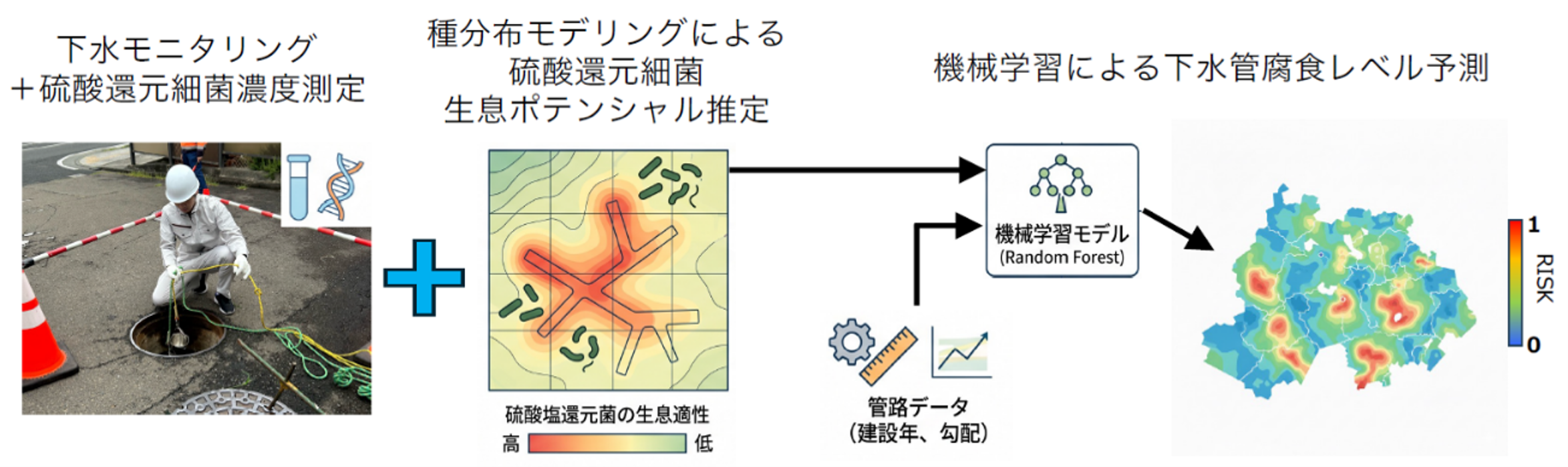
図1.下水モニタリングと種分布モデリングの組み合わせによる下水道管路腐食予測ワークフロー
<関連情報>
- https://www.tohoku.ac.jp/japanese/2026/10/press20261001-05-screening.html
- https://www.sciencedirect.com/science/article/pii/S0301479726024655
廃水環境DNAに基づく硫酸還元細菌のマッピングによる、種分布モデリングを用いたネットワーク規模の下水道腐食スクリーニング Wastewater environmental DNA-based mapping of sulfate-reducing bacteria for network-scale sewer corrosion screening using species distribution modeling
Junming Zhang, Kanki Watanabe, Wakana Oishi, Daijiro Mizutani, Mohan Amarasiri, Daisuke Sano
Journal of Environmental Management Available online: 24 September 2026
DOI:https://doi.org/10.1016/j.jenvman.2026.131005
Highlights
- Literature screening and qPCR identified SRB targets.
- Species distribution models predicted SRB habitat potential.
- SDM-derived SRB habitat improved RF prediction of sewer deterioration.
- Microbe-informed framework supports targeted sewer pipe inspection prioritization.
Abstract
The deterioration of extensive underground sewer networks presents a critical global challenge, as traditional inspection methods are difficult to scale under resource constraints. This study evaluates whether wastewater environmental DNA (eDNA)-derived habitat potentials of sulfate-reducing bacteria (SRB) can provide additional predictive information for network-scale sewer corrosion screening. We applied a species distribution modeling (SDM) framework to three targets: the two literature-selected and locally detected SRB genera, Desulfovibrio spp., Desulfobulbus spp., and the functional gene dsrB, using wastewater samples collected across the predefined target network over two years, achieving an optimal Area Under the Receiver Operating Characteristic Curve (ROC-AUC) of 0.925 for Desulfobulbus spp. Given the established role of SRB in sewer sulfide production, the SDM-derived habitat potentials were subsequently used to train a machine learning model to classify pipeline corrosion status defined by the municipal CCTV assessment. Using the two-year mean habitat potentials, a Random Forest (RF) model achieved the highest test-set Area Under the Precision-Recall Curve (PR-AUC) of 0.670. For the selected RF model, test-set permutation importance, measured as the decrease in PR-AUC after feature permutation, was highest for pipe age. Among the microbial predictors, the SDM-derived habitat-potential features for Desulfobulbus spp. and dsrB showed comparable importance, followed by that for Desulfovibrio spp. These findings demonstrate a scalable, data-driven framework for sewer corrosion screening and support inspection prioritization across unsampled pipe spans within the investigated target network.