2026-08-25 ロイヤルメルボルン工科大学(RMIT)
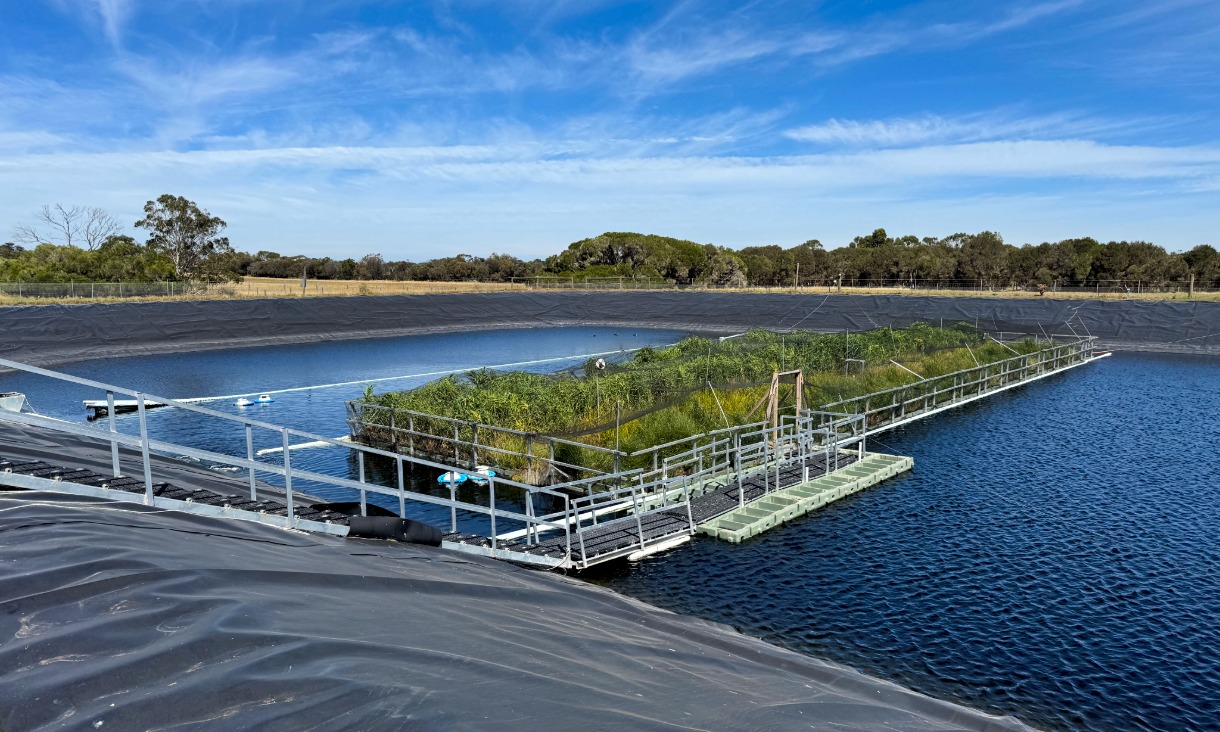
The floating wetland in a holding lagoon at Westernport Water wastewater treatment plant on Phillip Island, southeastern Australia.
<関連情報>
- https://www.rmit.edu.au/news/all-news/2026/aug/floating-wetland-study
- https://www.sciencedirect.com/science/article/pii/S0301479726021237
人工浮遊湿地は、廃水処理池からの温室効果ガス排出量を削減する Constructed floating wetlands cut greenhouse gas emissions from wastewater lagoons
Lukas Schuster, Peter I. Macreadie, John Awad, Divina Navarro, Martino E. Malerba
Journal of Environmental Management Available online: 11 August 2026
DOI:https://doi.org/10.1016/j.jenvman.2026.130663
Highlights
- A full-scale floating wetland cut greenhouse gas emissions from a wastewater lagoon.
- CO2-equivalent emissions declined by 22-31% over two years.
- Methane emissions declined by 32-66%.
- Carbon dioxide and nitrous oxide emissions declined by 24-36% and 18%, respectively.
- GHG emission reductions occurred within 4-7 months, preceding nutrient reductions.
Abstract
Wastewater treatment is a significant, yet often overlooked, contributor to global greenhouse gas emissions, accounting for ∼1.6% of anthropogenic emissions (∼0.77 Gt carbon dioxide [CO2]-equivalent per year), including 7-10% of methane (CH4) and nitrous oxide emissions (N2O). However, scalable mitigation options remain scarce. Constructed floating wetlands (CFWs) are widely used to reduce nutrient loads in wastewater systems, but their potential to reduce greenhouse gas emissions at full operational scales remains unclear. We conducted a two-year, full-scale trial of a CFW in a wastewater holding lagoon in southeastern Australia. The lagoon was divided into paired treatment (with the CFW) and control channels using baffle curtains. At the start and end of each channel, we continuously monitored greenhouse gas fluxes using hourly chamber concentration measurements and collected monthly water samples to assess water quality. On average, CO2-equivalent emissions in the treatment channel were 22-31% lower than in the control, primarily driven by reduced CH4 emissions (32-66%), with additional reductions in CO2 (24-36%) and N2O emissions (18%). Total Kjeldahl nitrogen levels (primarily organic nitrogen) declined by 12%, whereas nitrate and phosphorus remained unaffected. Notably, emission reductions emerged within four to seven months of CFW installation, preceding detectable nutrient reductions, which only became evident after 12 months. Altogether, our findings provide one of the first full-scale demonstrations that CFWs can substantially reduce greenhouse gas emissions from wastewater lagoons and support their potential as a nature-based pathway for decarbonising the water sector.