2026-07-08 東北大学
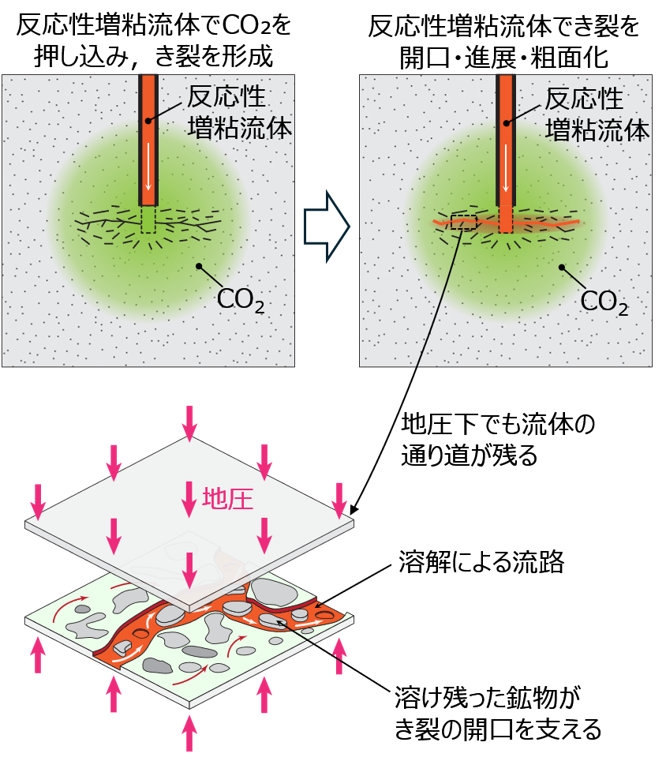
図1.CO2水押破砕と反応性増粘流体による閉じにくいき裂形成の概念図。き裂表面の不均一な溶解により凹凸が形成され、地圧下でも流体の通り道が残りやすくなる。
<関連情報>
- https://www.tohoku.ac.jp/japanese/2026/07/press20260708-03-fracturing.html
- https://www.nature.com/articles/s43247-026-03768-6
CO₂反応性破砕は、破砕生成と化学的粗面化を組み合わせることにより、応力耐性のある透水性を生み出す CO2 reactive fracturing creates stress-resistant permeability by coupling fracture generation and chemical roughening
Luis Salalá,Eko Pramudyo,Kevin Ryano,Kazumasa Sueyoshi,Ryota Tamura,Jiajie Wang,Kiyotoshi Sakaguchi,Sho Ogata,Kazumi Osato,Takuya Teraoka & Noriaki Watanabe
Communications Earth & Environment Published:02 July 2026
DOI:https://doi.org/10.1038/s43247-026-03768-6 Unedited version
Abstract
Permeability enhancement in subsurface reservoirs is commonly achieved by hydraulic or CO2-based fracturing, yet the resulting benefits are often short-lived because fracture apertures progressively close as effective stress increases. This limitation constrains the long-term performance of geothermal, carbon storage, and other subsurface energy systems. Here, we introduce CO2 reactive fracturing, a coupled hydraulic–chemical stimulation strategy that creates stress-resistant flow paths by integrating CO2-driven fracture initiation with localized chemical roughening of fracture surfaces. Using true-triaxial stress experiments on porous andesitic tuff, we show that viscosity-controlled water-assisted CO2 fracturing alone predominantly generates tensile, mated fractures with limited aperture stability. In contrast, introducing a shear-thinning reactive assisting fluid composed of a chelating agent and a minor fluoride source confines flow to fractures and induces localized dissolution of aluminosilicate and Fe-bearing minerals. This process increases fracture-surface roughness while suppressing reactive-fluid infiltration into the surrounding matrix, thereby enhancing aperture retention and sustaining permeability under elevated effective stress. Our results establish a general mechanism by which fracture generation and chemically induced roughening act synergistically to produce durable permeability, with broad implications for subsurface energy production and carbon storage applications.