2026-07-16 東北大学
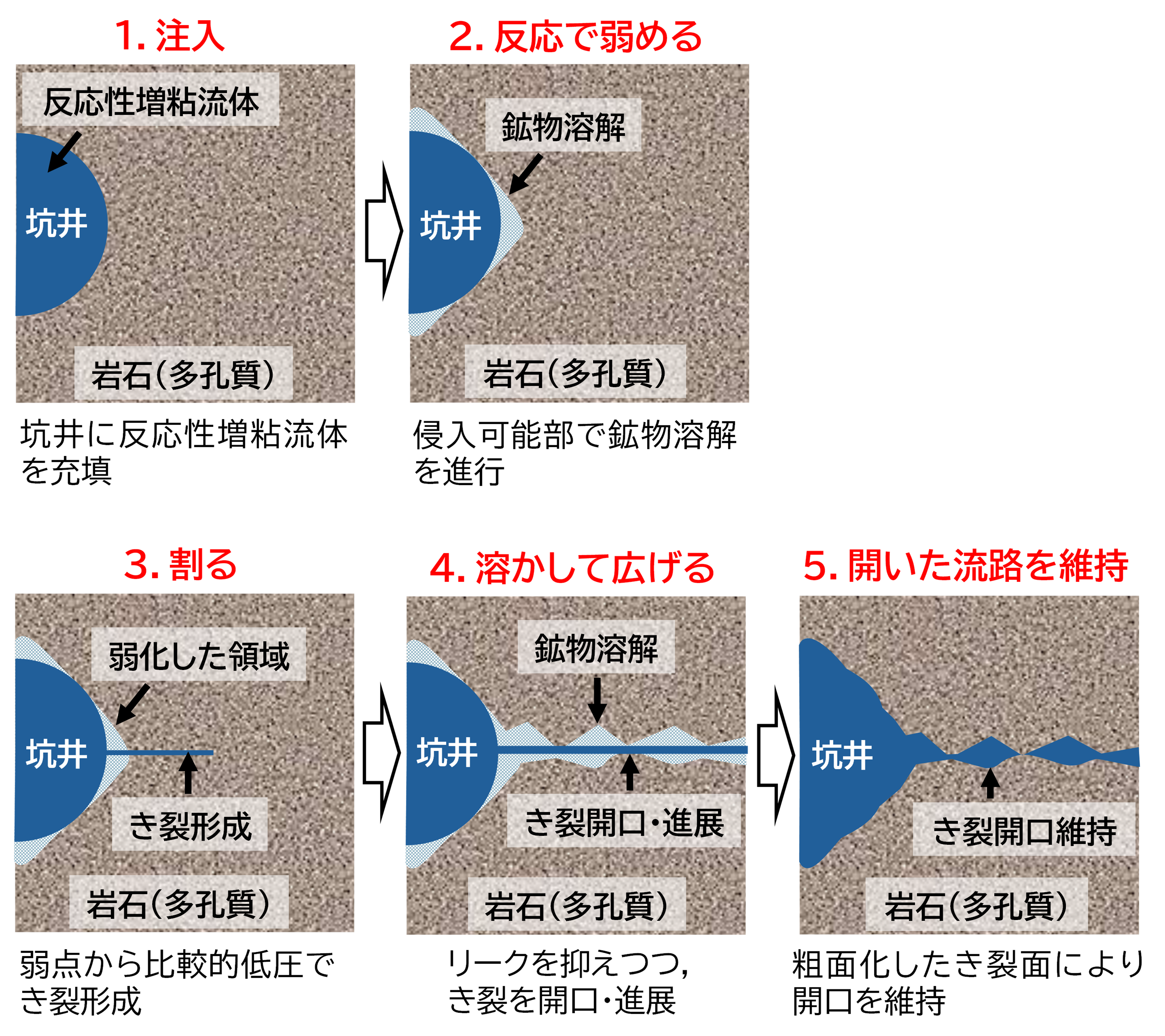
図1. 反応性増粘流体破砕法の概念図
<関連情報>
- https://www.tohoku.ac.jp/japanese/2026/07/press20260716-03-viscous.html
- https://www.sciencedirect.com/science/article/pii/S0375650526001562
火山岩の反応性粘性流体による破砕:化学的弱化が粘性による圧力上昇を相殺する Reactive viscous fluid fracturing of volcanic rocks: Chemical weakening offsets viscosity-induced pressure increase
Eko Pramudyo, Nagi Obata, Luis Salalá, Jiajie Wang, Noriaki Watanabe
Geothermics Available online: 13 July 2026
DOI:https://doi.org/10.1016/j.geothermics.2026.103752
Highlights
- Water-like fluids were ineffective in creating large-aperture fractures.
- Viscous fluids reduced infiltration but increased fracturing pressure.
- GLDA-based reactive viscous fluids widened fractures at relatively low pressure.
- Pre-existing fractures were propagated and branched in volcanic reservoir rocks.
- Reactive viscous fluid fracturing is promising for low-pressure stimulation.
Abstract
Hydraulic stimulation of volcanic reservoirs can be hindered by strong fluid infiltration into pores, vesicles, and microfractures, which suppresses pressure build-up and limits the formation of conductive fractures. Increasing fluid viscosity can reduce fluid loss, but typically at the cost of higher fracturing pressure. Here, we tested whether this viscosity–pressure trade-off can be mitigated by combining viscosity control with chemical weakening of the rock matrix. Triaxial fracturing experiments were conducted at 180 °C on volcanic rocks using water-like fluids, non-reactive viscous fluids, and reactive viscous fluids composed of the biodegradable chelating agent N,N-bis(carboxymethyl)-L-glutamic acid (GLDA) and the biopolymer scleroglucan. Water-like fluids showed strong matrix infiltration and were ineffective at generating large-aperture fractures. Increasing viscosity suppressed infiltration and promoted wider fractures, but increased fracturing pressure. When GLDA was added to the viscous fluid, fracture aperture and fracture-network complexity increased further, while fracturing pressure in the benchmark andesitic tuff experiments remained comparable to that during water injection despite the much higher fluid viscosity. The results are consistent with chemically induced weakening offsetting the pressure increase normally associated with viscous fluids. Additional experiments on andesitic lava and rhyolitic reservoir rock suggest that reactive viscous fluids can also propagate pre-existing fractures and promote branching in volcanic rocks with contrasting pore structures. These findings highlight the potential of reactive viscous fluid fracturing as a low-pressure stimulation strategy for geothermal reservoirs, with possible relevance to proppant-less reservoir stimulation.