20026-06-29 物質・材料研究機構,東北大学,東京大学
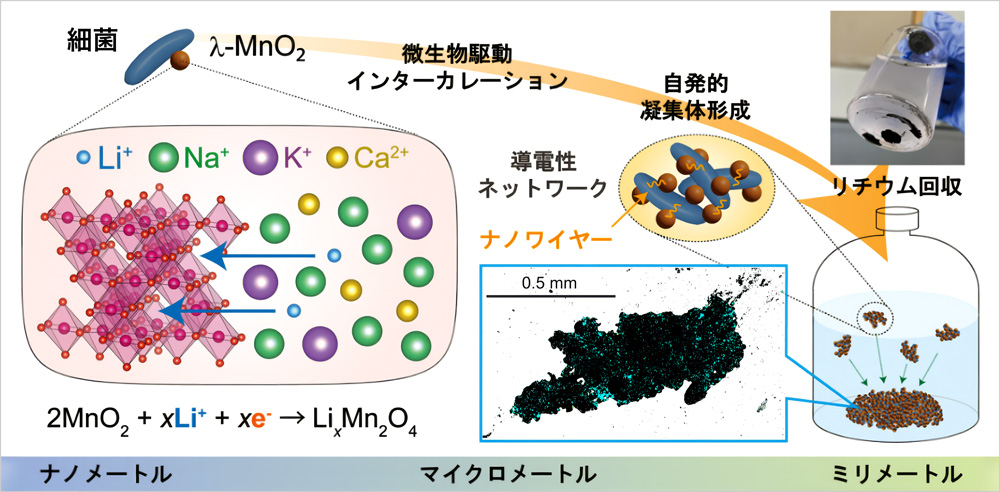
図: (左) 細菌 MR-1 の細胞内で乳酸が酸化されて発生した電子が、細胞外のλ-MnO2ナノ粒子へ受け渡され(細胞外電子伝達:EET)リチウムが取り込まれる。(中央) 続いて、細菌と材料粒子が自発的に集合し、ナノワイヤーで電気的に接続された導電性ネットワークを形成し、さらにリチウムを取り込む反応が活発化する。(右) マクロスケールでは、ミリメートルサイズの凝集体が反応容器の底に沈降し、均一なリチウム回収が進行する。
<関連情報>
- https://www.nims.go.jp/press/2026/06/202606290.html
- https://www.nature.com/articles/s41467-026-74500-3
電極を用いない生体電気化学的インターカレーションによる、スケーラブルなリチウム回収 Electrode-free bioelectrochemical intercalation for scalable lithium recovery
Kohei Shimokawa,Duyen Minh Pham,Heng Yi Teah,Xizi Long,Yasunori Kikuchi & Akihiro Okamoto
Nature Communications Published:29 June 2026
DOI:https://doi.org/10.1038/s41467-026-74500-3
Abstract
Electrochemical intercalation materials offer selective lithium recovery from saline streams, but conventional electrode architectures impose scale-up constraints. Here we report an electrode-free bioelectrochemical intercalation process in which a dissimilatory metal-reducing bacterium, Shewanella oneidensis MR-1, drives lithium uptake into λ-MnO2. The system self-assembles into microbe–mineral agglomerates that sustain electrochemical-rate intercalation without external wiring, forming a recoverable lithiated slurry. Over 95% of lithium was recovered from seawater within hours, with less than 1% co-intercalation of competing metal ions. Bottom-up self-agglomeration, in which extracellular and cell-surface cytochromes facilitate efficient electron transfer, enables scale-up. The generality and energetic basis of this mechanism are further supported by reproducing the key behaviour in an orthogonal FePO4 host with negligible abiotic reactivity. Techno-economic and life-cycle analyses for Li2CO3 production suggest that the process reduces brine water loss while maintaining competitive costs. These results establish self-assembled bioelectrochemical intercalation as a route to lithium recovery from saline streams.