2026-06-03 ジョージア工科大学
<関連情報>
- https://research.gatech.edu/rising-ashes-hidden-supply-critical-elements
- https://pubs.acs.org/doi/10.1021/acs.est.5c16688
イオン液体を抽出剤および電解質として用いた石炭フライアッシュからの希土類元素の電気化学的回収 Electrochemical Recovery of Rare-Earth Elements from Coal Fly Ash Using Ionic Liquids as both Extractant and Electrolyte
Anuja Tripathi,Ting Liu,Joe F. Bozeman III,Ching-Hua Huang,Xing Xie
Environmental Science & Technology Published: May 27, 2026
DOI:https://doi.org/10.1021/acs.est.5c16688
Abstract
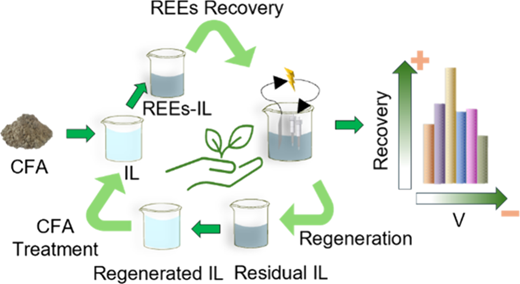
Rare-earth elements (REEs) are critical for medical technologies, electronics, and clean energy. Coal fly ash (CFA), a byproduct of coal combustion, offers a promising alternative REE source. However, efficient extraction and separation of REEs from CFA remain challenging due to the complex composition of CFA. This study introduces a sustainable method for REE recovery using a recyclable ionic liquid, betainium bis(trifluoromethylsulfonyl)imide ([Hbet][Tf2N]), which serves both as the extractant from CFA and as the electrolyte in electrodeposition. In the first stage, [Hbet][Tf2N] preferentially extracts REEs from CFA through leaching. In the second stage, the REE-enriched ionic liquid undergoes electrochemical deposition using amperometry techniques, where REEs are reduced and deposited onto the electrode. The deposition experiments were conducted from −0.5 to −2.0 V vs a Pt quasi-reference electrode in a three-electrode setup comprising titanium as the working electrode and platinum as both the reference and counter electrodes. Varying the applied potential enabled potential-dependent preferential REE deposition. At −0.5 V, neodymium (Nd) showed preferential recovery, reaching 25% with a separation factor of 37 over other REEs. In contrast, applying a more negative potential increased overall deposition, yielding ∼50% Nd recovery and 10–20% recovery for the remaining REEs. After recovery, the ionic liquid was regenerated and reused for a subsequent electrochemical recovery cycle. Overall, this study demonstrates a feasible approach for REE recovery from CFA waste, with potential to enhance resource utilization within the REE supply chain.