2026-07-09 東北大学
<関連情報>
- https://www.tohoku.ac.jp/japanese/2026/07/press20260709-03-permeability.html
- https://www.nature.com/articles/s43247-026-03658-x
グリーンキレート剤とフッ化水素酸の相乗効果により、地質学的CO2貯留層における坑井近傍刺激のための持続的な鉱物溶解が可能になる Green chelating agent‒hydrofluoric acid synergy enables sustained mineral dissolution for near-wellbore stimulation in geological CO2 storage formations
Jiajie Wang,Ryota Tamura,Hitomi Hirano,Masahiko Yagi,Tetsuya Tamagawa,Luis Salalá,Eko Pramudyo & Noriaki Watanabe
Communications Earth & Environment Published:05 June 2026
DOI:https://doi.org/10.1038/s43247-026-03658-x Unedited version
Abstract
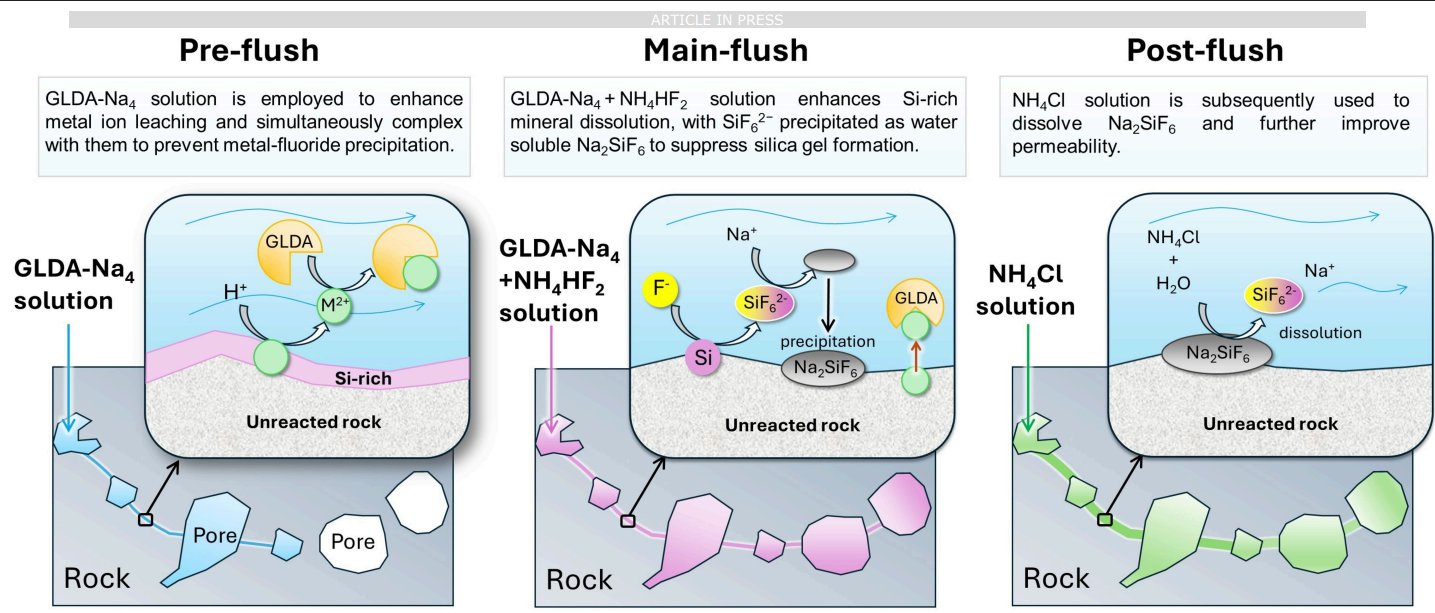
Chemical stimulation to enhance near-wellbore permeability can be important where injectivity improvement is needed in low-permeability deep saline aquifer rocks relevant to geological carbon dioxide storage. Hydrofluoric acid-based stimulation accelerates silicate dissolution, but silica-rich secondary phases may impair permeability if dissolved silicon accumulates excessively. Here we present a stimulation strategy that combines a biodegradable glutamic-acid-derived chelating agent with ammonium bifluoride and brine flushing to sustain mineral dissolution while controlling the fate of dissolved silicon. Laboratory batch and flow-through experiments on sandstone and sandy siltstone from deep saline aquifers show that dissolved silicon can be temporarily removed from the aqueous phase as sodium hexafluorosilicate and then flushed out under diluted conditions. This process sustained mineral dissolution and increased both brine and nitrogen permeabilities by more than one order of magnitude within several hours, demonstrating promise for near-wellbore treatment of low-permeability storage formations.