2026-08-10 マンチェスター大学
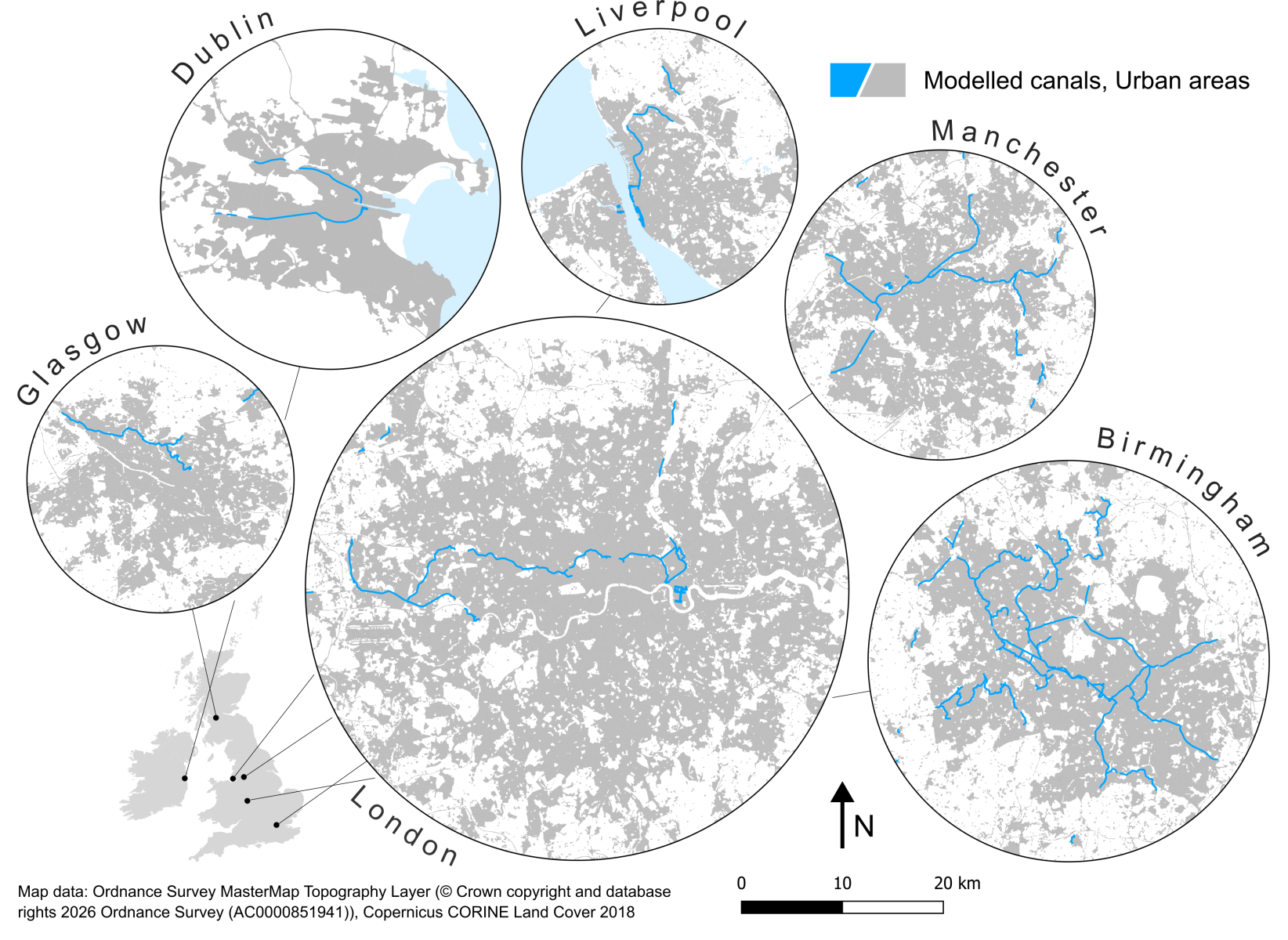
urban canals graphic
<関連情報>
- https://www.manchester.ac.uk/about/news/urban-canals-can-cut-temperatures/
- https://www.nature.com/articles/s41467-026-75731-0
運河が都市の気温に与える影響に関する全国規模の評価 A national-scale assessment of the impact of canals on urban temperatures
M. D. Tomkins,H. McDonald,J. J. Huck & J. Tippett
Nature Communications Published:10 August 2026
DOI:https://doi.org/10.1038/s41467-026-75731-0
Abstract
Urban populations are particularly vulnerable to heat-related mortality and morbidity. Climate-responsive urban design, which can include development of green and bluespaces, has the potential to offset climate change-related impacts. Compared to greenspaces, the effects of bluespaces on urban temperatures have received comparatively little attention, with uncertainty regarding the magnitude of urban cooling. In this study, we develop an energy balance model to estimate the thermal effects of canals and apply this to the canal network of Great Britain and Ireland. Here we show that the modelled canals provide an average annual daytime cooling effect of ~0.8 °C (0.7 – 1 °C) within the immediate vicinity of the canal network, with more pronounced cooling during spring and early summer (~1.2 – 1.4 °C) and during heatwaves (~1.5 – 2.3 °C). While thermal effects are not exclusively positive, our results indicate that canals can improve thermal comfort and reduce heat risk, with related benefits for population health and wellbeing.