2026-09-14 ミシガン大学
<関連情報>
- https://news.umich.edu/weighing-600-million-buildings-to-help-construct-a-more-efficient-future/
- https://www.nature.com/articles/s44284-026-00510-3
6億棟の建物の重量を分析することで、世界の都市における物質的不平等と効率化の道筋が明らかになる Weighing 600 million buildings reveals global urban material inequality and efficiency paths
Jinchao Song,Kun Sun,Benjamin P. Goldstein,Xiaoye Tong,Lizhe Wang,Marco Helbich,Qiance Liu,Menglin Dai,Xiang Li & Gang Liu
Nature Cities Published:08 September 2026
DOI:https://doi.org/10.1038/s44284-026-00510-3
Abstract
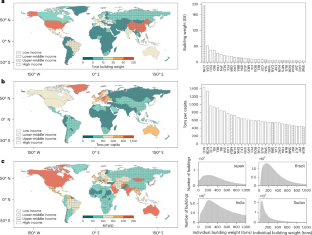
Material accumulation in built environment is a defining feature of urbanization, shaping resource use, energy demand and emissions. Yet, spatially explicit assessments of global building material stocks remain scarce, limiting understanding of how urbanization and urban form influence material demand and sustainability outcomes. Here we construct a harmonized global database of building-level material stocks covering more than 600 million buildings, revealing an in-use stock of 835 Gt. Per capita stocks rise sharply with affluence, with low- and middle-income countries reaching only 14–33% of high-income levels. Although material accumulation generally scales with economic development, it increases sublinearly with income because urban form strongly moderates demand, producing diverse and path-dependent trajectories. Scenario analysis indicates that, if rapidly urbanizing regions follow historical development pathways, global building material stocks could expand by 419 Gt by 2050. However, adopting a dense and homogeneously low urban form could reduce this growth by about 30%, highlighting urban planning as a key lever for sustainable development.