2026-10-13 ヒューストン大学
<関連情報>
- https://www.uh.edu/news-events/stories/2026/october/10132026-carbon-capture-data-centers.php
- https://pubs.acs.org/esthag/article/doi/10.1021/acs.est.6c06512/5461310/Small-Modular-Electrochemical-Containers-for
- https://tiisys.com/blog/2025/08/25/post-174086/
AIデータセンターの脱炭素化のための小型モジュール式電気化学コンテナ Small Modular Electrochemical Containers for Decarbonization of AI Data Centers
Ahmad Hassan; Prince Aleta; Mohsen Afshari; Abdelrahman Refaie; Mim Rahimi
Environmental Science & Technology
DOI:https://doi.org/10.1021/acs.est.6c06512
Abstract
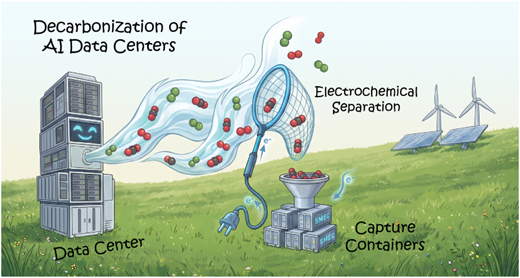
The rapid growth of artificial intelligence (AI) is increasing data-center electricity demand and reinforcing the near-term role of fossil-fuel power generation. Decarbonizing this infrastructure requires carbon capture systems that are efficient, compact, modular, and compatible with space-constrained data centers. Here, we evaluate Small Modular Electrochemical Containers (SMECs) as a deployment-oriented application of a two-stage, membraneless electrochemically mediated amine regeneration (EMAR) process. The design integrates CO2 absorption and electrochemical desorption within one gas-diffusion-electrode cell, eliminating absorber columns and ion-exchange membranes. Single-cell experiments were conducted under simulated natural-gas and coal-derived flue gas. Polarization mapping identified optimized operating conditions, which were then used in a 300-cycle, 50-h accelerated stability test with periodic polarity switching. The cell maintained repeatable voltage and CO2 absorption/desorption profiles, with absorption and desorption efficiencies of ∼90% under optimized conditions. The energetics ranged from 50–85 kJe/molCO2, and GC/IC analyses showed no detectable gaseous or liquid side products. The paper further includes theoretical modeling of SOx and NOx effects on the absorbent. In a case study for a 360 MW data-center power plant, the TEA showed that fewer than 20 SMEC units could achieve near-complete decarbonization, increasing the levelized electricity cost from about $58/MWh to $74/MWh.