2026-11-11 愛媛大学
<関連情報>
- https://www.ehime-u.ac.jp/data_relese/pr_20261111_eng/
- https://www.nature.com/articles/s41598-026-76688-2
畳み込みニューラルネットワークを用いた短波海洋レーダによる海面波浪と海上風の同時推定 Simultaneous retrieval of sea-surface waves and winds from high-frequency radar using a convolutional neural network
Tomoya Kataoka, Hitoshi Tamura, Takashi Fujiki & Satoshi Fujii
Scientific Reports Published:10 November 2026
DOI:https://doi.org/10.1038/s41598-026-76688-2
Abstract
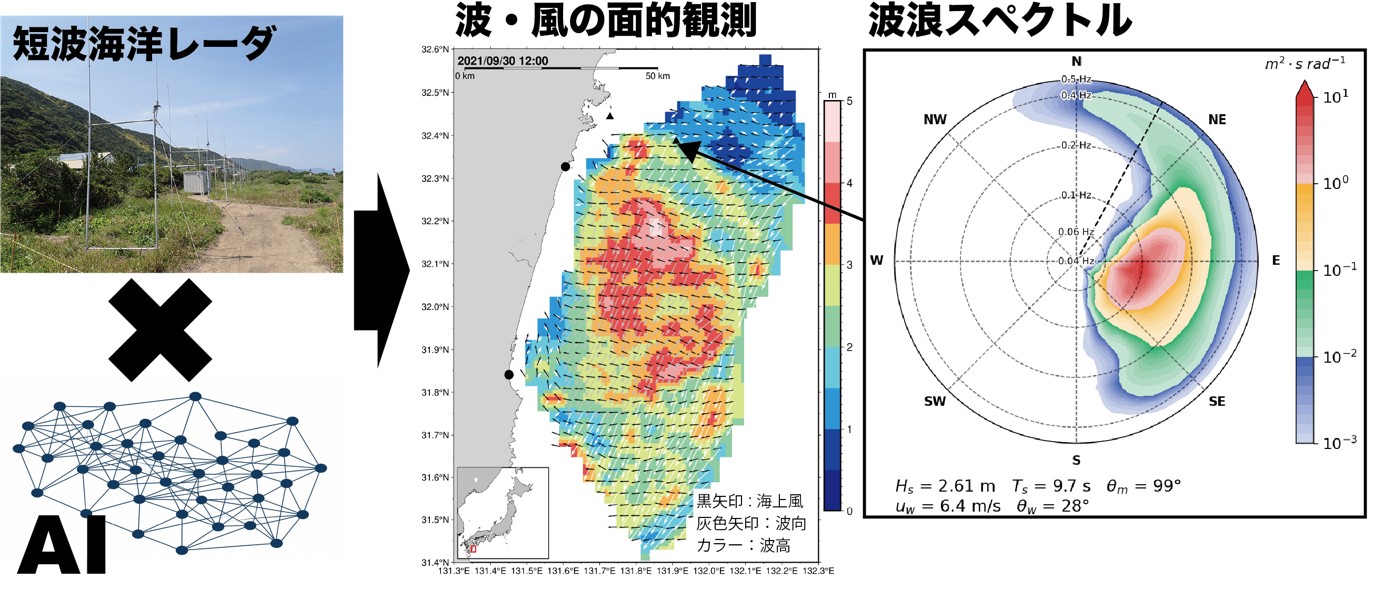
High-frequency (HF) ocean radar is a powerful land-based remote sensing technique, yet extracting wave and wind parameters from Doppler spectra remains challenging. Conventional inversions struggle with spectral saturation, low signal-to-noise ratios, and directional ambiguity, traditionally necessitating dual-station networks. This study proposes a unified Convolutional Neural Network (CNN) framework to concurrently extract directional wave spectra and sea-surface wind vectors directly from entire Doppler spectra. We evaluated Single and Quad Point Selection (SPS/QPS) in single- and dual-station setups using datasets from the Hyuga-nada Sea (13.5 MHz) and Kii Channel (24.515 MHz). The CNN was less affected by the numerical instabilities of nonlinear inversions: compared with a Bayesian inversion method, it yielded more stable directional wave spectra and required two orders of magnitude less computation time (CPU versus GPU). In the validation phase, single-station QPS achieved directional accuracy comparable to dual-station networks by leveraging spatial continuity among adjacent radial beams, suggesting that the 180° directional ambiguity can be mitigated without supplementary constraints. Identical model architectures with normalized variables also operated across disparate radar frequencies. These findings could reduce the reliance on dual-station geometry and expand operational coverage, although wind-speed retrieval remained only partially resolved and generalization depends heavily on training dataset diversity.