2026-08-05 ノースウェスタン大学
<関連情報>
- https://news.northwestern.edu/stories/2026/08-2/as-urban-tree-shade-shrinks-mortality-rises
- https://agupubs.onlinelibrary.wiley.com/doi/10.1029/2025GH001651
都市部の樹冠面積の増加は死亡率の低下と関連している:シカゴの近隣地域における長期分析 Increasing Urban Tree Canopy Associated With Reduced Mortality: A Longitudinal Analysis of Chicago Neighborhoods
Harrison C. Garcia, Peter M. Graffy, Benjamin W. Barrett, Maxime A. Visa, Jenny Jia, Evan Mallen, Raed Mansour, Graham Briggs, Trent Ford, Donald J. Wuebbles, Norrina Allen, …
Geohealth Published: 05 August 2026
DOI:https://doi.org/10.1029/2025GH001651
Abstract
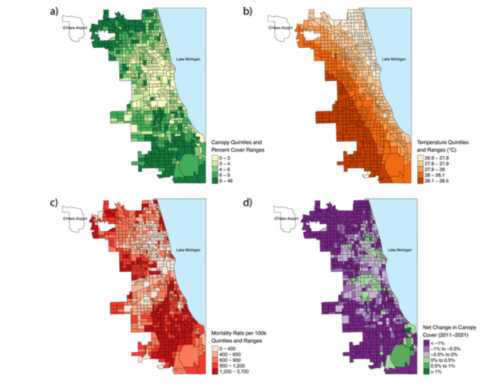
Urban tree canopy is known to mitigate ambient heat and improve physical and mental health but the longitudinal interactions and impacts of tree canopy, temperature, and mortality are not well understood. Using high resolution tree canopy estimates, temperature, mortality, and demographic data from 2011 to 2021, we implemented negative binomial generalized estimating equations to model all-cause and disease-specific mortality based on tree canopy cover, year-to-year changes in tree canopy cover, and maximum temperature, adjusting for area-level demographics in Chicago, IL. We used K-means clustering to identify patterns of canopy, temperature, and mortality disparities across Chicago community areas. There were 220,711 decedents during the study period (115,974 male, 104,734 female; mean age at death: 69.4 ± 19.9 years). Existing canopy coverage was not statistically significantly associated with mortality (incidence rate ratio [IRR] = 0.995, 95% confidence interval [CI] = 0.984–1.007). However, each year-to-year percent increase in canopy was associated with around a 10% reduction in mortality (IRR = 0.902, [0.871–0.935]) with significant associations for cause-specific cardiovascular (IRR = 0.908, [0.869–0.948]), mental health (IRR = 0.836, [0.784–0.892]), musculoskeletal (IRR = 0.907, [0.832–0.989]), and respiratory (IRR = 0.887, [0.833–0.945]) diseases. Cluster analysis identified that neighborhoods on Chicago’s South and West sides were characterized by high temperatures, greater absolute canopy loss despite elevated baseline canopy levels, and increased mortality. Among the hottest neighborhoods, canopy-temperature interaction models demonstrated that areas experiencing larger year-to-year canopy losses had higher yearly mortality. Protecting tree canopy cover from losses over time, particularly in vulnerable areas with higher temperatures, may present a key opportunity to reduce mortality and mitigate impacts of climate change.