
2026-06-10 スタンフォード大学
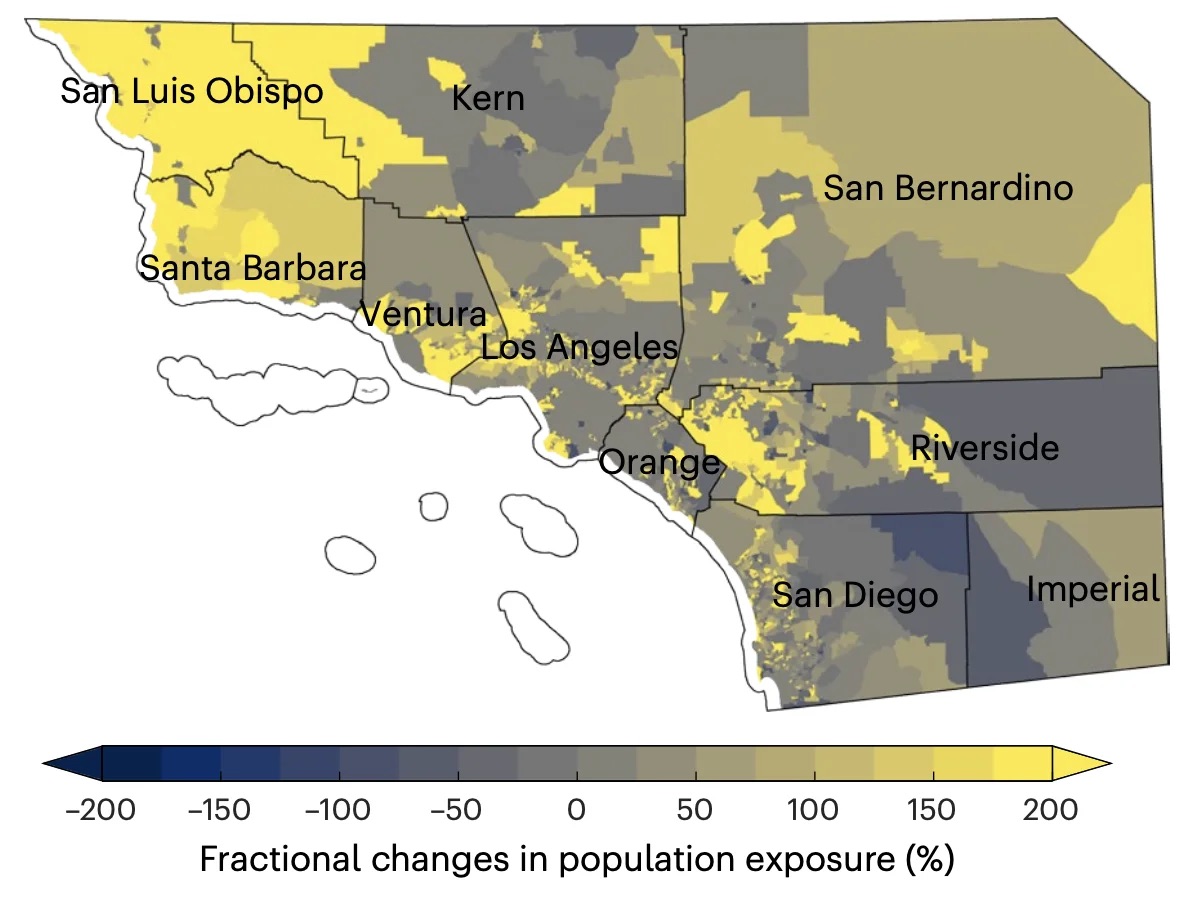
Fractional changes (%) in population exposure to landslides induced by tropical cyclone rainfall events with a 100-year return period at the census tract level from 2000-2050. | Zhu et al. (Nature Climate Change 2026)
<関連情報>
- https://news.stanford.edu/stories/2026/06/hurricane-rainfall-landslide-risk-southern-california
- https://www.nature.com/articles/s41558-026-02633-w
南カリフォルニアにおける熱帯低気圧による降雨量と土砂崩れリスクの増加 Increasing tropical cyclone rainfall and landslide risk in Southern California
Laiyin Zhu,Yuan Wang,Kerry Emanuel,Sasha N. Tolstoff & Noah S. Diffenbaugh
Nature Climate Change Published:10 June 2026
DOI:https://doi.org/10.1038/s41558-026-02633-w
Abstract
Tropical cyclone (TC) risk has long been overlooked in Southern California due to its relatively low historical frequency. Here we couple a physics-based TC downscaling model with a probabilistic, machine learning-based landslide model to assess changes in TC rainfall and landslide risks in ten Southern California counties. Historical simulations and reanalysis data show robust agreement in downscaled TC rainfall. The return period of Hurricane-Hilary-magnitude rainfall (~100 mm) shortens by 50% from 110 years to 54 years in a future high-emission warming scenario. Eastern Pacific sea surface temperature is projected to increase by 2.7 ± 0.7 °C from 1985–2014 to 2071–2100 and, together with enhanced mid-tropopsheric moisture, contribute to increasing TC rainfall risk. All Southern California counties exhibit growth in areas exposed to landslides from 2000 to 2050. The steepest fractional increases in landslide exposure exist in low-income households with a heavy tax burden. These findings underscore a pressing need for proactive and equitable planning and mitigation strategies for TC rainfall-induced hazards.

