
2026-07-29 東北大学
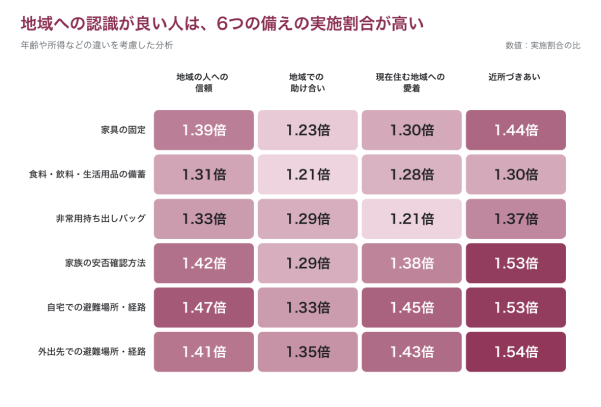
図1. 地域に関する4つの認識と6つの備えの関連
<関連情報>
- https://www.tohoku.ac.jp/japanese/2026/07/press20260729-03-neighborhood.html
- https://www.sciencedirect.com/science/article/pii/S2212420926003298
日本における防災行動のモニタリング:社会、居住環境、近隣地域に関連した勾配 Monitoring disaster preparedness behaviors in Japan: social, residential, and neighborhood-related gradients
Masahide Koda, Nahoko Harada, Kenta Minamitani, Kazuya Fujii, Masatsugu Orui, Shinichi Kuriyama, Atsushi Hozawa, Takahiro Tabuchi
International Journal of Disaster Risk Reduction Available online: 19 July 2026
DOI:https://doi.org/10.1016/j.ijdrr.2026.106317
Abstract
Disaster preparedness is central to disaster risk reduction (DRR), yet item-level evidence on how preparedness behaviors vary across social, residential, and neighborhood contexts remains limited, particularly in Japan, given recurrent earthquakes, typhoons, and floods and anticipated Nankai Trough scenarios. Using data from 28,481 respondents in the 2023 Japan COVID-19 and Society Internet Survey (JACSIS2023), we examined six respondent-reported preparedness behaviors: securing furniture against overturning, stockpiling food, beverages, and other supplies, preparing an emergency go-bag, deciding family safety-confirmation methods, knowing evacuation sites/routes when at home, and knowing evacuation sites/routes when away from home. We estimated weighted prevalence across demographic, socioeconomic, household, and residential groups and fitted adjusted log-link quasi-Poisson models for associations with four individual-level neighborhood/community perception indicators: local trust, local helpfulness, attachment to the current area, and good relationships with neighbors. Prevalence ranged from 28.9% for family safety-confirmation methods to 42.4% for stockpiling food, beverages, and other supplies; no item was reported by more than half of respondents. Lower preparedness clustered among adults aged 20-29 years, people living alone, never-married respondents, private renters, and lower-income groups. All four perception indicators were positively associated with all six behaviors. Good neighbor relations showed large PRs for family safety-confirmation methods (PR 1.53, 95% CI 1.40-1.67), home-based evacuation-route knowledge (1.53, 1.43-1.64), and away-from-home evacuation-route knowledge (1.54, 1.41-1.68). Although internet-based, cross-sectional sampling limits representativeness and causal interpretation, preparedness should not be approached only as an individual risk-communication problem; community-level DRR efforts strengthening neighborhood ties and local information-sharing pathways may increase protective actions before disasters.

