2025-07-23 ジョンズ・ホプキンス大学(JHU)
<関連情報>
- https://hub.jhu.edu/2025/07/23/improved-carbon-capture-sewage-treatment/
- https://pubs.acs.org/doi/10.1021/acsestengg.5c00276
水再生施設における処理水の二酸化炭素回収・貯留への利用を探る Exploring the Use of Treated Water in Water Reclamation Facilities for Carbon Dioxide Capture and Sequestration
Nakyeong Yun,and Ruggero Rossi
ACS ES&T Engineering Published: June 2, 2025
DOI:https://doi.org/10.1021/acsestengg.5c00276
Abstract
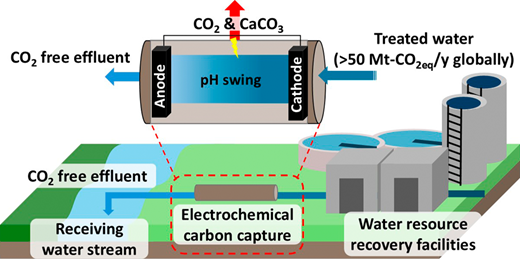
Water reclamation facilities contribute to the emission of greenhouse gases during the treatment of wet waste and following the release of the treated water effluent in receiving water bodies due to the high concentration of greenhouse gas precursors dissolved in the effluent. Here, an electrochemical cell was used to capture inorganic carbon dissolved in the treated liquid effluent discharged from four wastewater treatment plants. A pH gradient was induced in the effluent flowing in the electrochemical cell, facilitating the transformation of bicarbonate ions into carbon dioxide and solid metal carbonates that were removed from solution with overall efficiencies exceeding 57 ± 2% (96 ± 0.5% as gaseous CO2 at the anode and 19 ± 4% as CaCO3 at the cathode). Understanding how solution chemistry and electrochemical parameters dictated the performance of CO2 capture allowed to optimize operational parameters and reactor architecture to minimize energy demand to 3.4 kWh/kg CO2 with real treated effluents, a value that makes this approach competitive with current technologies for commercial CO2 capture from the ocean or the atmosphere. Finally, performance stability was investigated by operating the cell for 55 h, quantifying carbon capture efficiency and energy demand over time. This study demonstrates for the first time that electrochemical CO2 capture from treated water effluents provides an end-of-the-pipe decarbonization approach that, when implemented in conjunction with the use of renewable electricity, can accelerate the decarbonization of the water infrastructure and reduce the emission of greenhouse gases in the environment.