2025-12-10 カリフォルニア大学リバーサイド校 (UCR)
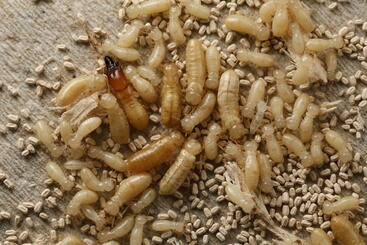
One soldier termite, many workers, larvae and fecal pellets in the background. (Dong-Hwan Choe/UCR)
<関連情報>
- https://news.ucr.edu/articles/2025/12/10/fecal-tests-reveal-active-termite-attacks
- https://academic.oup.com/jee/advance-article-abstract/doi/10.1093/jee/toaf293/8304385
西部乾材シロアリ(Blattodea:Kalotermitidae)の新鮮および熟成糞便ペレットの細菌群集と、最近のまたは活発な侵入のバイオマーカーとしての利用可能性 Bacterial communities of fresh and aged fecal pellets in western drywood termite (Blattodea: Kalotermitidae) and their potential use as biomarkers of recent or active infestations
Nicholas A Poulos ,Lyna Ngor ,Chow-Yang Lee ,Quinn McFrederick ,Dong-Hwan Choe
Journal of Economic Entomology Published:27 October 2025
DOI:https://doi.org/10.1093/jee/toaf293
Abstract
In addition to serving as a telltale sign of infestation, drywood termite fecal pellets can reveal information about the colony that produced them. In this study, the bacterial communities of fresh and aged fecal pellets of Incisitermes minor (Hagen) were investigated to test the hypothesis that patterns of bacterial succession can be used to distinguish fresh from aged pellets and therefore indicate an active infestation. Fecal pellets were collected from drywood termites that fed on either the wood they were collected from or Douglas-fir (D-fir) commercial lumber. Freshly produced, 3-mo, 6-mo, and 12-mo-old pellets underwent 16S rRNA gene sequencing to identify the bacteria present in the samples. Natural-wood pellets contained on average over five times the amount of bacterial DNA compared to D-fir pellets. Up to a 190-fold decrease in estimated bacterial DNA quantity was detected between fresh to 12-mo-old pellets. Comparisons of bacterial community compositions between the samples of different ages revealed diversity indices that were significantly different between fresh and aged pellets from D-fir. Furthermore, the current study identified five unique families of bacteria that were consistently present in all fresh fecal pellet samples from D-fir but completely absent in the fecal pellet samples that were aged for certain amounts of time. In addition to serving as a basis for the characterization of the microbiome of I. minor fecal pellets, the current findings suggest multiple candidate biomarkers which may be further investigated to develop a cost-effective method to distinguish freshly produced from aged fecal pellets.