2026-02-10 東京理科大学
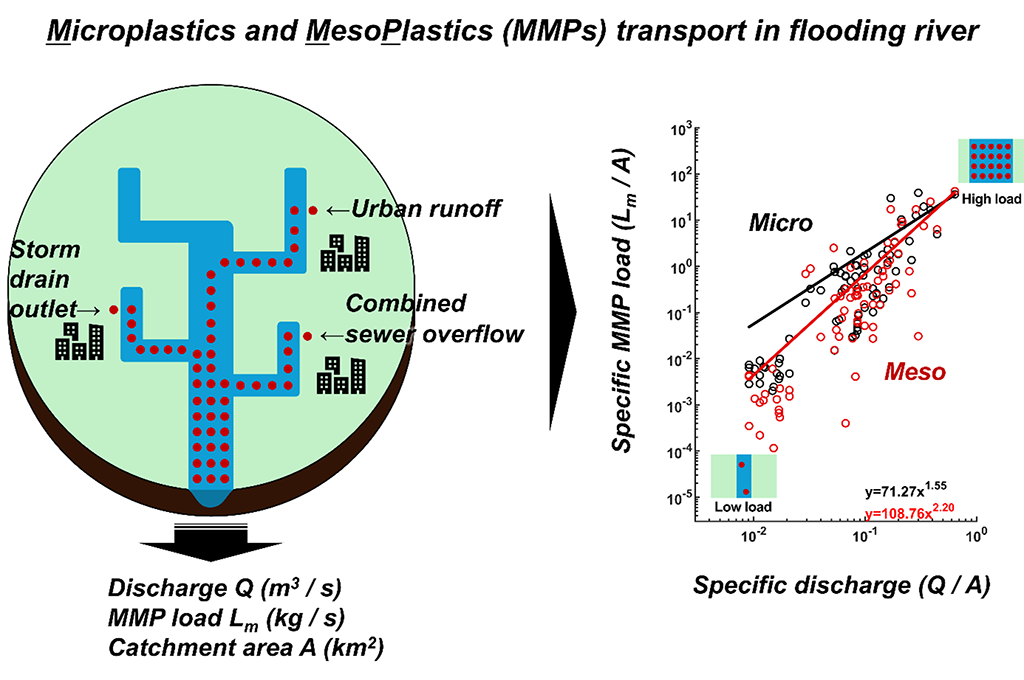
図 本研究の概要
<関連情報>
- https://www.tus.ac.jp/today/archive/20260210_4443.html
- https://www.sciencedirect.com/science/article/pii/S0043135425020780
河川の洪水がプラスチックを海へ運ぶ仕組み:マイクロプラスチックとメソプラスチックの負荷と排出量の関係に関する事例研究 How flooding rivers deliver plastic to the ocean: A case study of microplastic and mesoplastic load–discharge relationships
Mamoru Tanaka, Yasuo Nihei
Water Research Available online: 15 December 2025
DOI:https://doi.org/10.1016/j.watres.2025.125175
Highlights
- Direct observations of flooding rivers to test effect on plastic particle transport.
- Load–discharge relationship established based on six floodings over four rivers.
- Mesoplastic load was more responsive to discharge than microplastic.
- Hysteresis on load–discharge diagram with high load for rising stage of hydrograph.
- Suspended sediment concentrations suggested as a proxy for plastic concentrations.
Abstract
Rivers are recognized as the primary pathways of plastic input from the land to the ocean. However, the role of flooding rivers in transporting microplastics and mesoplastics (MMPs) remains elusive, and quantification of suspended MMP loads under different high-flow magnitudes is lacking. Herein, the effects of high flows on MMP transport were investigated by conducting continuous, hourly surface sampling over the rising and falling stages of hydrograph in four Japanese rivers with catchments that included urban, agriculture, and forest areas and relatively high population densities of 1560–6800 people/km2. During six rainfall events (total precipitation 8.8–117.9 mm), MMP mass concentrations increased from 1 to 4 orders of magnitude compared to those during low-flow conditions. MMP load variations among high-flow events were well described by empirical power-law relationships between specific discharge (Q) vs. specific mass load (Lm): and for microplastics and mesoplastics, respectively. Specific mass loads were higher in the rising stage than in the falling stage, exhibiting a clockwise loop within load–discharge scatterplots. River-specific load–discharge relationships were not well defined, likely due to the limited range of observed discharge in each river. Time-series analyses revealed that 90 % of the annual mesoplastic load in one river was transported within only 11.8 % of the year, which corresponded with periods exhibiting high discharge, while microplastics exhibited similar but less pronounced episodic transport. This finding suggests that, without monitoring flooding conditions, substantial fraction of MMP transport will be overlooked. Potential use of suspended sediment concentrations as a proxy for MMP concentration was also examined. The study findings contribute to a better understanding of the transport dynamics of plastic debris in flooding rivers.