
2025-10-15 インペリアル・カレッジ・ロンドン(ICL)
インペリアル・カレッジ・ロンドンの研究チームは、潮汐発電の環境影響を再評価し、「生態系への深刻な悪影響」という従来の懸念が科学的根拠に乏しいことを示した。欧州・アジア・北米の50超の研究をレビューした結果、古い建設手法に起因する一部の問題を除き、潮汐発電施設は長期的に安定した、むしろ生物多様性が高まる生態系を形成していることが確認された。魚類や海洋哺乳類の衝突リスクも極めて低い。研究者は、潮汐発電が再生可能エネルギー供給だけでなく、海面上昇や高潮からの防御にも寄与し得ると指摘。政策的支援と環境監視の継続が鍵であると強調した。成果は『Ecological Solutions and Evidence』誌に掲載。
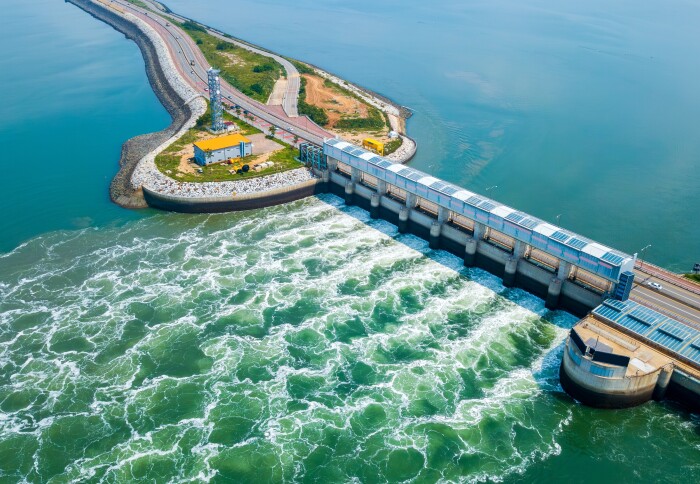
Sihwa Lake Tidal Power Station, South Korea
<関連情報>
- https://www.imperial.ac.uk/news/270053/new-study-challenges-ecological-fears-around/
- https://besjournals.onlinelibrary.wiley.com/doi/full/10.1002/2688-8319.70124
誤った懸念?潮力発電の生態学的影響に関する証拠が明らかに Misplaced fears? What the evidence reveals of the ecological effects of tidal power generation
Sylvia E. Ascher, Iris M. Gray, C. M. (Tilly) Collins
Ecological Solutions and Evidence Published: 02 October 2025
DOI:https://doi.org/10.1002/2688-8319.70124
Abstract
- Tidal energy is a dependable and clean power source that stands as a compelling alternative to fossil fuels. Despite this promise, tidal energy projects face barriers to practical implementation, and objections to proposed schemes often stem from perceptions of adverse ecological effects.
- Early concerns surrounding the ecological effects of tidal range energy infrastructure arose largely from the construction stages of barrages rather than from later, longer term operational stages. Though research on this was under-planned, there is now a literature base. We synthesise the available current evidence of effects that both long-established range and novel stream technologies have on marine environments through systematic and exploratory literature approaches.
- Fifty-four articles have been included in this review and produce a nuanced picture accompanying a steep learning curve in both tidal power system construction and operation.
- Few of the widespread concerns are substantiated by evidence or in long-term monitoring of existing projects. There is evidence of alterations in hydrodynamics and sediment flux at tidal range power plants, as well as some animal behavioural changes around tidal stream turbines, though many apprehensions either remain unsubstantiated or result in neutral effects on marine ecosystems. Several positive ecological effects are identified such as greater productivity and species diversity within tidal range basins, as well as enhanced seabird foraging hotspots surrounding tidal stream turbines. Maintaining a tidal regime as close as possible to its prior state appears key to minimising adverse ecological effects and has been a major learning point for tidal range
- Practical implication. This work provides foundations for environmental impact assessments of future tidal projects and may enable more informed choices and facilitate a priori mitigation planning.

