2026-05-11 東京科学大学
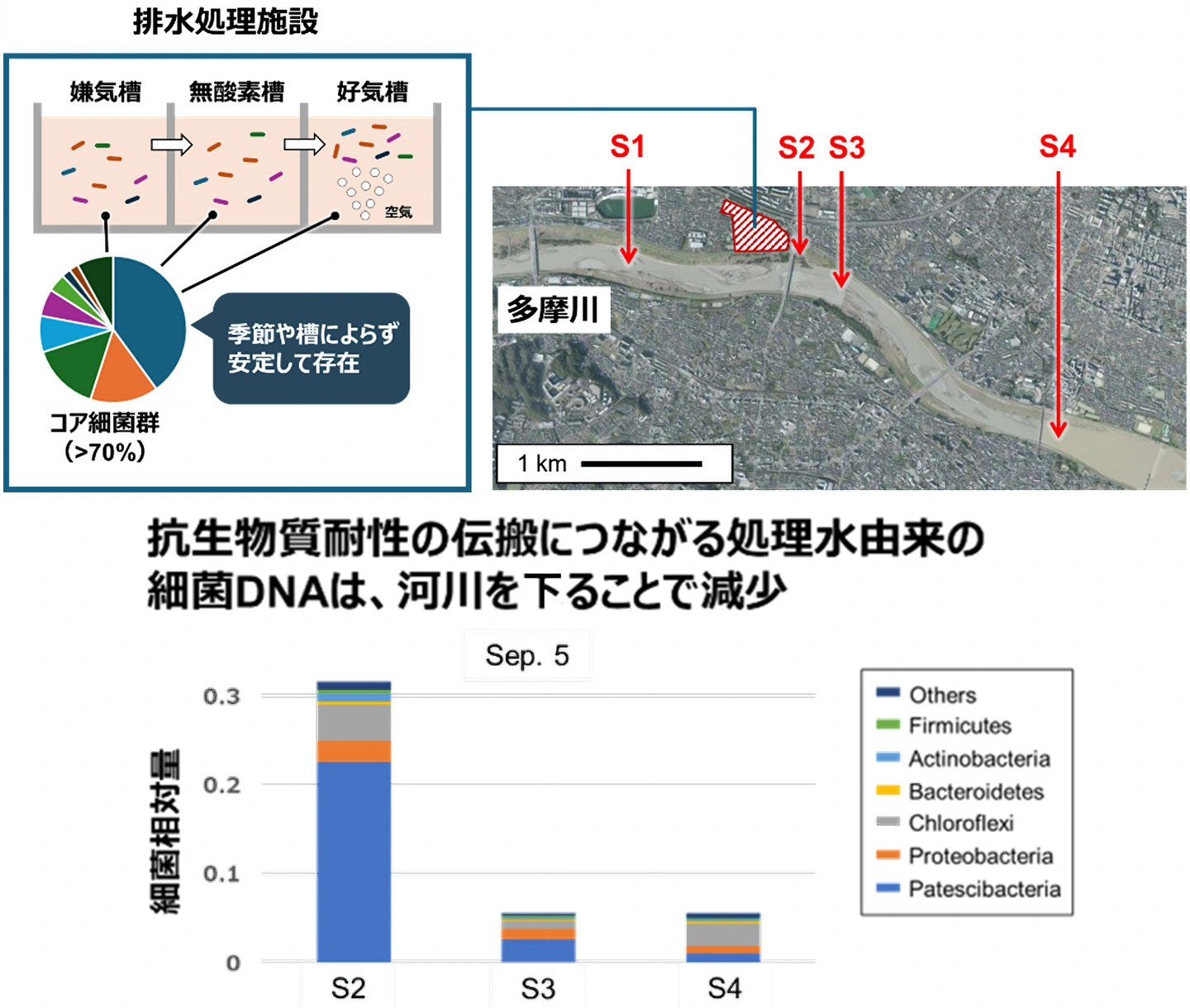
国土地理院撮影の空中写真を加工して作成
<関連情報>
- https://www.isct.ac.jp/ja/news/g868zyyz23iv#top
- https://journals.plos.org/plosone/article?id=10.1371/journal.pone.0346342
廃水処理における細菌の役割と、処理済み廃水が河川の細菌生態系に与える影響 The role of bacteria in wastewater treatment and the impact of treated wastewater on riverine bacterial ecosystems
Akifumi Nishida ,Mayuko Nakagawa,Masayuki Yamamura
PLOS One Published: April 15, 2026
DOI:https://doi.org/10.1371/journal.pone.0346342
Abstract
Spatiotemporal analysis of bacterial communities in wastewater can explain the role of bacteria in removing organic matter, phosphorus, and nitrogen as well as the impact of wastewater treatment on riverine ecosystems. This study investigated the bacterial dynamics within an anaerobic–anoxic–oxic (A2O) wastewater treatment plant (WWTP), comprising anaerobic, anoxic, and aerobic tanks, in Tokyo and its impact on the receiving Tama River. 16S rRNA gene analysis and ion chromatography were used to monitor bacterial composition and nutrient concentrations, respectively, to assess the effectiveness of nutrient removal across seasonal temperature variations, and the influence of treated wastewater on riverine bacterial communities. The A2O process effectively removed nutrients, but the nitrification efficiency was affected by temperature, with decreased temperatures correlating with reduced Nitrospira abundance, while nitrate concentrations increased due to higher influent ammonium loads. The WWTP bacterial community exhibited a polarized structure with a dominant core community that was stable over time and across tanks. The abundance of bacterial DNA introduced into the river via treated wastewater decreased downstream, indicating the spatial attenuation of the wastewater treatment impact on the riverine ecosystem. This study demonstrated the temperature sensitivity of WWTP processes, and the transient impact of treated wastewater discharge on river bacterial communities, thereby emphasizing the importance of understanding these dynamics for effective environmental conservation.