2026-08-20 シンガポール国立大学(NUS)
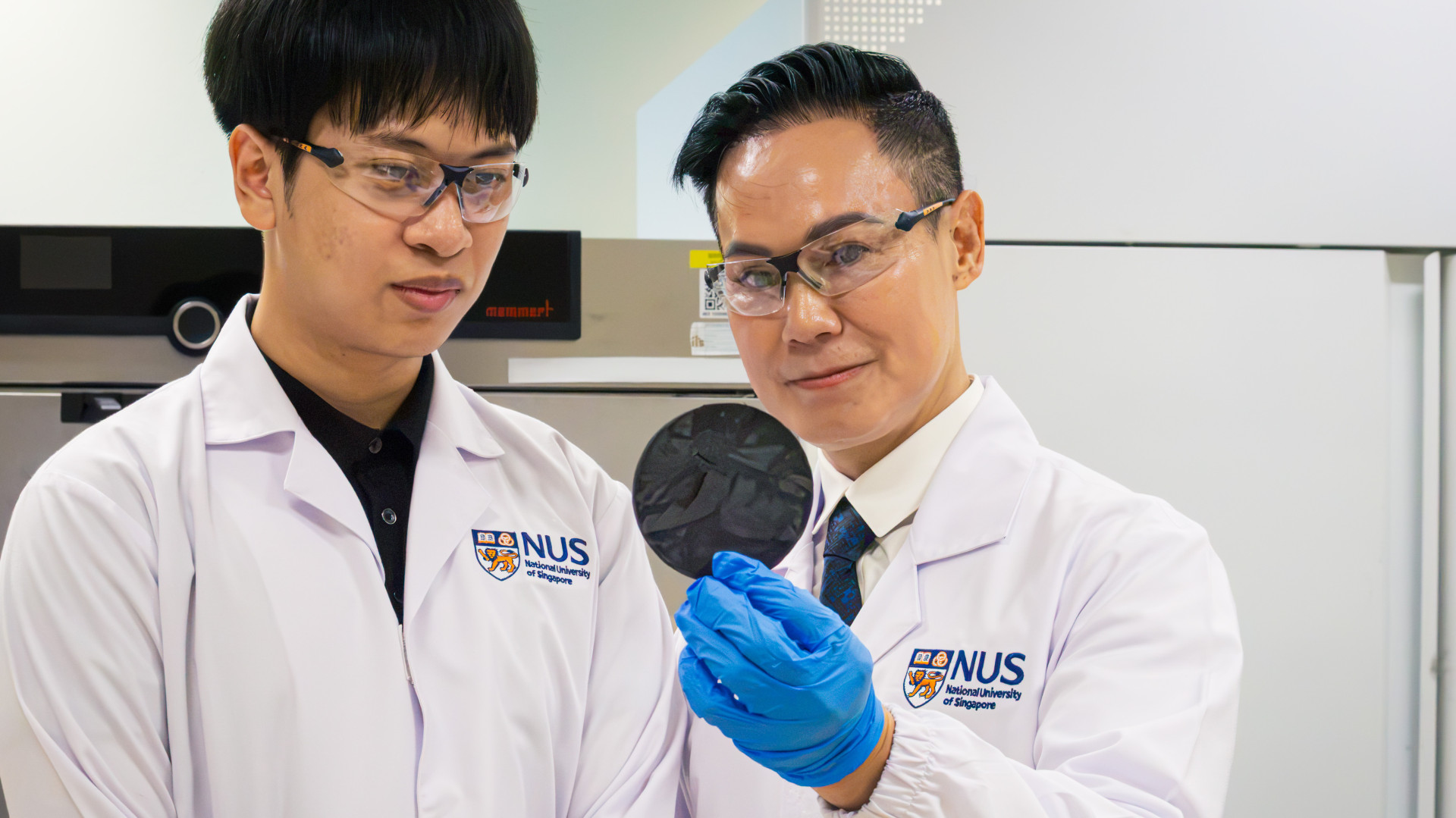
Mr Ngo Minh Quang Phan (left), first author of the study, and Associate Professor Duong Hai Minh, who led the research, with a carbon fibre epoxy aerogel developed by the NUS team.
<関連情報>
- https://news.nus.edu.sg/giving-aircraft-waste-second-life/
- https://www.sciencedirect.com/science/article/abs/pii/S0956053X26003715
炭素繊維/エポキシ廃棄物を細胞適合性のある多機能エアロゲルに完全アップサイクルし、断熱・遮音、および油流出事故の浄化に利用する Full-material upcycling of carbon Fiber/Epoxy waste into cytocompatible Multi-functional aerogels for thermal and acoustic Insulation, and oil spill cleaning
Quang M.N. Phan, Nga H.N. Do, Yanli Zheng, Huy-Du Do, Thanh-Tan Nguyen, Meng Wang, Truong Quoc Thinh, Hieu Tran-Van, Son Truong Nguyen, Hai M. Duong
Waste Management Available online: 29 June 2026
DOI:https://doi.org/10.1016/j.wasman.2026.115701
Highlight
- First-ever upcycling of CFE waste into multifunctional lightweight aerogels.
- Aligned lamellar pores enable 0.042–0.049 W/m·K conductivity; FEA validated.
- Inverse JCA model accurately predicts acoustic absorption with NRC up to 0.51.
- Hydrophobic aerogels show high oil uptake of 14.39 g/g with rapid kinetics.
- CFE aerogels are cytocompatible with > 88 % cell viability at all concentrations.
Abstract
Carbon fiber/epoxy (CFE) composites represent a growing industrial waste stream whose thermoset nature severely limits recyclability. Existing end-of-life treatments primarily focus on partial fiber recovery and often require energy-intensive or chemically aggressive processes, leading to material loss and secondary waste. No prior study has reported a solvent-free strategy that simultaneously upcycles both carbon fiber and epoxy fractions of CFE waste into a structured aerogel. Wet ball milling transforms CFE into a homogeneous mixture of fine powders and short fiber fragments, which is subsequently blended with sodium carboxymethyl cellulose (CMC) and freeze-dried to construct lightweight aerogels with aligned lamellar structures. The resulting aerogels exhibit low density (0.08–0.12 g/cm3), high porosity (91.25–94.51 %), and notable mechanical robustness (elastic modulus up to 418.95 kPa). These structural features enable multifunctional performance, including thermal insulation (0.042–0.049 W/m·K), acoustic insulation with a noise reduction coefficient up to 0.51, and oil-spill cleaning with high oil uptake of nearly 15 g/g after surface modification. Thermal performance is validated by finite element analysis using a 2D representative volume element (RVE), yielding effective thermal conductivity tensors in excellent agreement with experimental values. Acoustic performance is modeled via the inverse Johnson-Champoux-Allard (JCA) model, extracting five transport parameters including flow resistivity, porosity, tortuosity, and viscous and thermal characteristic lengths with simulated absorption coefficients closely matching measurements. Cytocompatibility further confirms biological safety, broadening applicability to non-toxic interfaces. Overall, through integrated experiments and computational simulations, this work demonstrates a practical and transferable framework for full-material upcycling of thermoset composite waste into high-value engineering materials.