
2026-04-08 北海道大学
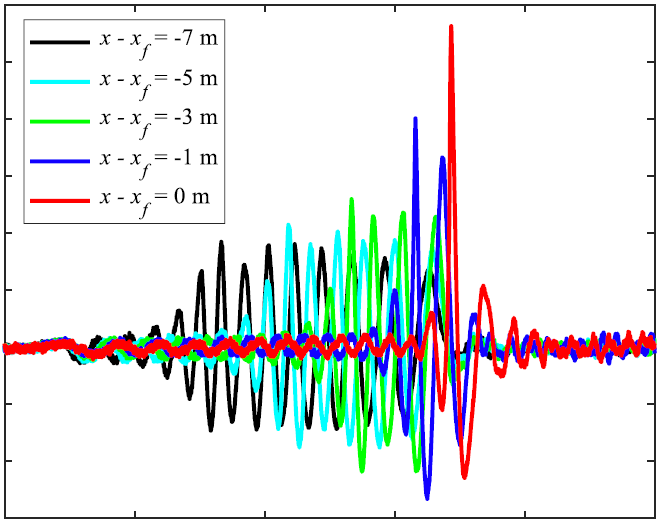
理論に従って造波された波群(黒)が伝播と共に縮小すると波高が増幅し、理論上の集中地点(x–xf=0m)で最大高さの巨大波となる(赤)。
<関連情報>
- https://www.hokudai.ac.jp/news/2026/04/post-2251.html
- https://www.hokudai.ac.jp/news/pdf/260408_pr4.pdf
- https://agupubs.onlinelibrary.wiley.com/doi/10.1029/2025JC023479
流れをもつ浅水領域の分散性波浪集中 Dispersive Wave Focusing in Shoaling Water With Currents
Y. Watanabe, T. Davey, D. M. Ingram
Journal of Geophysical Research: Oceans Published: 19 March 2026
DOI:https://doi.org/10.1029/2025JC023479
Abstract
A methodology creating dispersive focusing waves on constant depth, originally proposed by Rapp and Melville (1990), https://doi.org/10.1098/rsta.1990.0098, has provided a wide range of applications studying nonlinear waves, wave breaking, and rogue waves in the open ocean. When the wave focusing is considered in coastal regions, generally having depth variations and coastal currents, effects of shoaling on beaches and interactions with currents must be included for predicting wave growth. Here we present the general form of a chirp frequency achieving complete wave-energy focusing in arbitrary depth variations and currents. The proposed method has been validated through wave experiments in a wave flume with sloped beach and opposing currents. It was found that the current velocity significantly contributes to wave growth, achieving a maximum crest height 6.1 times higher than the incident wave in the strongest current considered. The dual effects of shoaling and radiation stress, intensified by the opposing current, contribute to the rapid growth of the wave energy density near the focusing point. Nonlinearity develops once waves are highly amplified, causing spectrum energy spread from the primary frequency band to wider frequencies depending on the current velocity. Whereas the nonlinear energy spread disappears after focusing when divergent waves travel in constant depth, the effects of shoaling and radiation stress maintain the nonlinear features of the waves behind the focus location on a beach. The proposed method achieving dispersive focusing will help in further understanding of nonlinear behaviors of breathers and wave breaking in arbitrary current and coastal geometry.
Plain Language Summary
Rogue waves are a well-known extreme event, with ocean waves manifesting with much larger amplitude than expected for the sea state. While most previous studies focused on the rogue waves created in the open ocean, any responses of the extreme waves in a shallower coastal region, generally having bathymetry changes and coastal currents, have not been understood. Here we proposed a novel methodology to create dispersive focusing waves in the presence of currents over an uneven seabed, which has been validated through wave flume experiments. We experimentally find that an opposing current significantly contributes to the wave growth at the focus point, resulting in a maximum crest height 6.1 times higher than the incident wave in the strongest current considered. Contributions of wave shoaling, radiation stress, and wave breaking on sloped beds in nonuniform currents to the wave energy balance and spectrum through a focusing process are specifically provided in this paper. The proposed method can be applied to various environmental scenarios in coastal regions, which may be useful for further investigations of near-shore extreme waves. The findings of this study potentially contribute to coastal hazard forecasting and structure designs against coastal rogue waves.

