
2025-10-01 愛媛大学,八千代エンジニヤリング株式会社,日本エヌ・ユー・エス株式会社
愛媛大学大学院理工学研究科の片岡智哉准教授らの研究グループは、八千代エンジニヤリング、日本エヌ・ユー・エス、オランダ・ワーゲニンゲン大学と共同で、深層学習を活用した河川プラスチック検出・分類・追跡ソフトウェアを開発した。従来の目視調査は労力や安全性に課題があり、特に洪水時の継続観測が困難だった。本ソフトは動画映像からプラスチックを自動識別(ボトル、袋、容器、その他の4種類)し、YOLOv8やDeep SORTを用いて追跡、さらに河川流速を組み合わせて輸送量を算定できる。これにより、複数地点・多様な条件下での継続的なモニタリングが可能となり、海洋プラスチック問題の実態解明や政策立案、施策効果の検証に貢献する。研究成果は国際学術誌 Water Research に掲載され、今後は河川プラスチックモニタリングシステム「PRIMOS」に搭載し実用化を進める予定である。
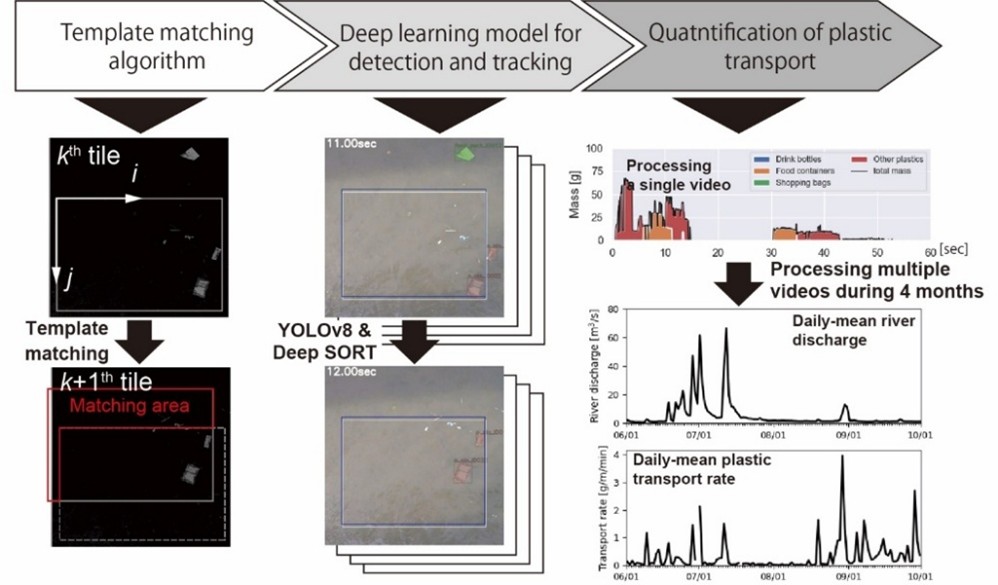 開発したソフトウェアの解析の流れ
<関連情報>
- https://www.ehime-u.ac.jp/data_relese/pr_20251001_eng/
- https://www.sciencedirect.com/science/article/pii/S0043135425015817
河川浮遊プラスチック輸送を定量するための画像解析ソフトウェア RiSIM: River surface image monitoring software for quantifying floating macroplastic transport
Water Research Volume 288, Part B, 1 January 2026, 124678
Tomoya Kataoka,Takushi Yoshida,Kenji Sasaki,Yoshinori Kosuge,Yoshihiro Suzuki,Tim H.M. van Emmerik
https://doi.org/10.1016/j.watres.2025.124678
Highlights
- RiSIM, a river surface image monitoring software, was newly developed.
- RiSIM quantifies floating macroplastic transport on river surfaces.
- Deep learning models were implemented to detect and track floating plastics.
- Temporal variabilities in RiSIM-derived plastic transport matched ground truth data.
- RiSIM revealed a significant relationship between plastic transport and discharge.
Abstract
Reliable and continuous plastic monitoring in rivers is essential for quantifying plastic flux and guiding mitigation efforts. One effective strategy for observing floating plastic transport is image-based monitoring using deep learning models. We developed river surface image monitoring software (RiSIM) to quantify floating macroplastic transport through three core processes: (1) a template matching algorithm, which identifies matching areas in a frame that resemble a template given in the previous frame; (2) deep learning models for plastic detection, classification, and object tracking; and (3) the evaluation of plastic transport rate in terms of both quantity and mass. The RiSIM-derived plastic transport rates were validated through a mark-release-recapture experiment and in-situ visual observation under both non-flood and flood conditions. The temporal variability and composition of the plastic transport rate in terms of quantity and mass were in good agreement with the ground truth data (r = 0.91 and 0.80, respectively). And also, it remained valuable for capturing the temporal variability in plastic transport rate (r = 0.87) via the comparison with in-situ visual observation, indicating that the RiSIM is valuable for assessing the increase in plastic transport rate due to a flood event. In fact, we found a significant relationship (r2 = 0.36 for quantity; r2 = 0.27 for mass) between daily-mean plastic transport rates and river discharge during flood events over four months. Accordingly, the RiSIM, as a near-field remote sensing technology, is a powerful tool for quantifying plastic transport and managing mis-managed plastic waste in river environments.

