
2026-06-03 チャルマース工科大学
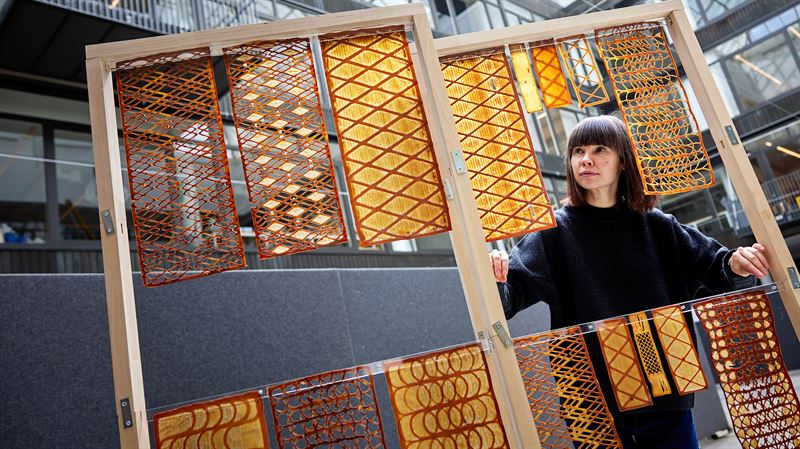
New and renewable architecture made from baker’s yeast. Image: Chalmers University of Technology | Henrik Sandsjö.
<関連情報>
- https://news.cision.com/chalmers/r/baked–printed–ready–premiere-of-architecture-made-from-yeast,c4356573
- https://www.sciencedirect.com/science/article/pii/S2095263526000245?via%3Dihub
建築用途向けの新規3Dプリント可能な酵母ベース材料 Novel 3D printable yeast-based materials for architectural applications
Yagmur Bektas, Malgorzata A. Zboinska, Cecilia Geijer, Tiina Nypelö, Zeinab Hefny
Frontiers of Architectural Research Available online: 5 March 2026
DOI:https://doi.org/10.1016/j.foar.2026.01.003
Abstract
Conventional building materials rely on non-renewable ingredients, contributing to global resource depletion. To address this challenge, bio-based alternatives from renewable nature-based biomasses are under development. This study presents one such alternative—a novel 3D-printable biomaterial from baker’s yeast. Optimized formulations contain 3% (w/v) yeast solution (intact or homogenized cells), 13% (w/v) aqueous microfibrillated cellulose solution (10% microfibril concentration), 1% (w/v) sodium alginate, 5% (w/v) glycerol, and water. Research methods included sequential formulation optimization, 3D printing, characterization of microscopic, rheological, tensile, and thermal degradation properties, and establishment of architectural attributes, encompassing shrinkage, deformation, light transmittance, color, and porosity. The material exhibited gel-like viscoelastic solid behavior (G′ > G″) supporting shape retention post-printing. Mechanical tests showed a maximum average tensile strength of 2.7 MPa and elongation at break of 25.2%. Large 3D-printed tile prototypes (20 cm × 50 cm) demonstrated low linear shrinkage along edges (2%–10%), tunable light transmittance (5.6%–31.6%), a four-color palette (NCS 4040-Y30R, NCS 5030-Y40R, NCS 3030-Y20R, NCS 3040-Y30R), and configurable porosity (solid, perforated, hybrid). These characteristics indicate the material’s application potential as 3D-printable lightweight architectural sheets for interior applications, which in the future could replace fossil-based products.

