2025-09-22 ロイヤルメルボルン工科大学(RMIT)
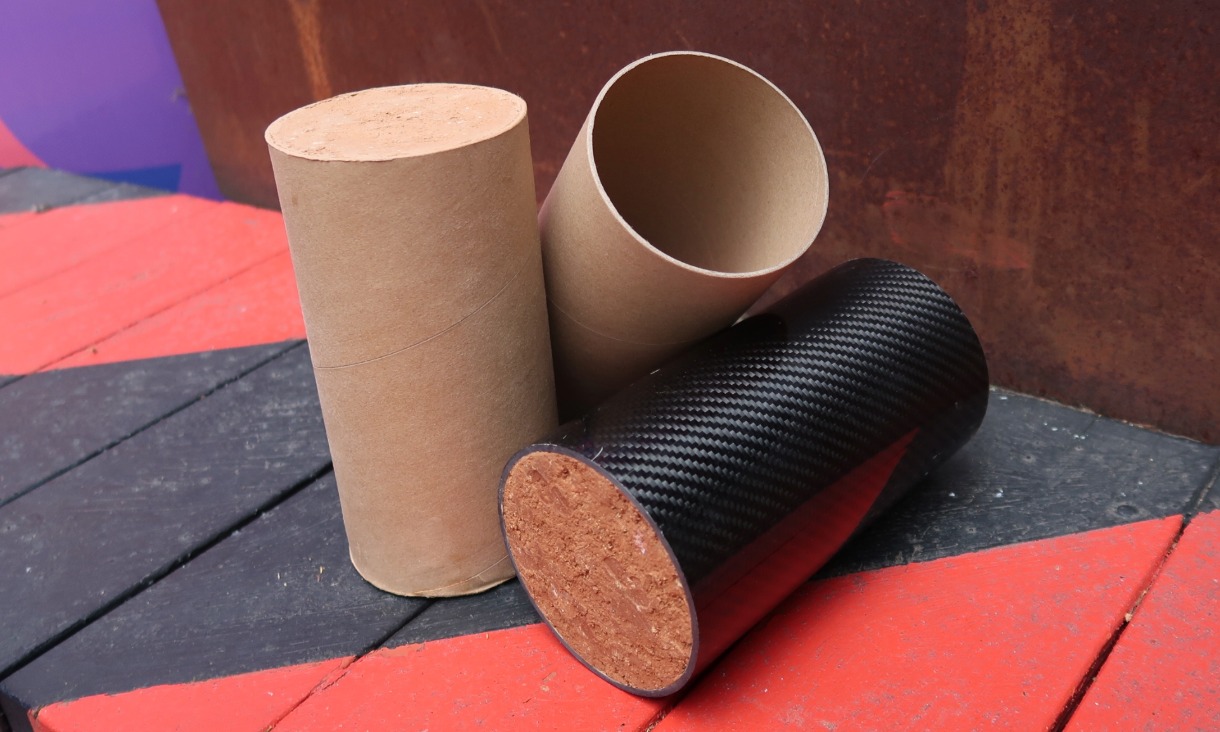
A cardboard-confined rammed earth column and a CFRP-confined rammed earth column.
<関連情報>
- https://www.rmit.edu.au/news/all-news/2025/sep/cardboard-construction
- https://www.sciencedirect.com/science/article/pii/S2352012425019320
- https://www.sciencedirect.com/science/article/pii/S0263822325006774
持続可能な建設に向けた段ボール封入式版築工法 Cardboard-confined rammed earth towards sustainable construction
Jiaming Ma, Hongru Zhang, Yuting Zhong, Vahid Shobeiri, Ngoc San Ha, Srikanth Venkatesan, Dilan Robert, Yi Min Xie
Structures Available online: 6 September 2025
DOI:https://doi.org/10.1016/j.istruc.2025.110117
Abstract
Environmental concerns regarding the widespread use of cement and concrete in the construction industry have intensified in recent years. As the industry seeks sustainable alternatives, cardboard—a mass-produced, recyclable material—has gained accelerating popularity for temporary buildings and structures with adequate durability. Simultaneously, renewed interest in the traditional rammed earth technique has emerged due to its extremely low embodied carbon and nearly zero cost. This study introduces an innovative cardboard-confined rammed earth (CCRE), integrating low-cost cardboard tubes with unstabilized rammed earth. CCRE cylinders with cardboard tube thicknesses ranging from 1 mm to 4 mm are fabricated and tested for compressive strength. Additionally, an analytical model is developed to predict the compressive strength of CCRE cylinders with varying dimensions. Comprehensive assessments of carbon footprints and life cycle costs are conducted to evaluate the environmental and economic advantages of the proposed composite. The results reveal that rammed earth core significantly enhances the structural performance of cardboard by more than tenfold, surpassing the strength of widely used cement-stabilized rammed earth. The CCRE not only offers substantial reductions in carbon emissions but also provides competitive life cycle costs, making it an appealing solution for sustainable low-rise building applications.
高性能土構造に向けたCFRP拘束式版築工法 CFRP-confined rammed earth towards high-performance earth construction
Jiaming Ma, Hongru Zhang, Vahid Shobeiri, Yuting Zhong, Jianjun Zhang, Yu Bai, Dilan Robert, Yi Min Xie
Composite Structures Available online: 23 July 2025
DOI:https://doi.org/10.1016/j.compstruct.2025.119512
Abstract
Rammed earth has traditionally been considered as a low-performance construction material. However, advancements in stabilization methods and construction techniques, combined with its inherent sustainability, have renewed interest in its use as a viable and sustainable building material. This study introduces a novel composite system that, for the first time, combines unstabilized rammed earth with carbon fiber-reinforced polymer (CFRP) confinement to significantly enhance the structural performance of rammed earth. The proposed composite system is investigated through axial compression tests with varying confinement thickness, carbon footprint evaluation, and life cycle cost assessment. The results demonstrate significant improvements in compressive strength and ductility, with strength values reaching 22.36 MPa, 64.38 MPa, and 75.68 MPa for 1 mm, 2 mm, and 3 mm CFRP confinements, respectively. Compared to CFRP-confined concrete, CFRP-confined rammed earth offers superior ductility, reduced environmental impact, and enhanced economic viability. Additionally, a predictive model is developed to estimate the strength of the proposed composite. These findings highlight the potential of CFRP-confined rammed earth for high-performance and sustainable earth construction.