2025-11-12 フィンランド技術研究センター(VTT)
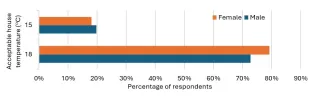
Figure 1: Acceptable indoor temperature thresholds by gender and age above 41 during energy shortage
<関連情報>
- https://www.vttresearch.com/en/project_news/new-definition-and-framework-introduced-energy-resilient-buildings-cold-climates
- https://www.sciencedirect.com/science/article/pii/S0378778825013635
- https://www.mdpi.com/2075-5309/14/9/2821
- https://www.mdpi.com/2075-5309/14/5/1453
- https://www.mdpi.com/1996-1073/16/14/5506
北欧の気候におけるエネルギー回復力に対する建物改修と再生可能エネルギー統合の影響:アンケートベースの閾値を用いた技術経済分析 Implication of building renovation and renewable integration on the energy resilience in the Nordic climate: Techno-economic analysis using questionnaire-based thresholds
Hassam ur Rehman, Rakesh Ramesh
Energy and Buildings Available online: 30 October 2025
DOI:https://doi.org/10.1016/j.enbuild.2025.116633
Highlights
- Analyzed the effects of long-term blackouts on the energy resilience of buildings.
- Proposed human-centered energy resilience thresholds based on survey responses.
- Habitability threshold varied based on gender, age, building type, and location.
- Low heating and stress increased in the old building and reduced with renovation.
- Survivability improved with renovation and integration of PV, storage and heat pump.
Abstract
As climate change worsens energy insecurity, resilience to long-term blackouts in cold climates is increasingly critical. Blackouts can compromise indoor heating, leading to serious habitability, health, and survivability risks. Yet, most existing regulatory frameworks lack clear definitions of minimum habitability and survivability thresholds, and often under examine the role of demographic and social factors. This study presents a novel, integrated, human-centric method that combines a single-stage occupants survey—designed to assess energy resilience awareness, occupant-defined habitability and survivability thresholds, and key demographic factors—with a detailed building performance simulation model. Survey data was collected from 378 participants residing in a cold climate region (Finland) and is integrated with simulations of both old and renovated residential buildings, incorporating various passive and active energy systems, including building envelope, photovoltaics (PV), battery storage, and heat pumps. This interdisciplinary approach enables a comprehensive techno-economic analysis that effectively bridges social perceptions with technical assessments of energy resilience. Moreover, a new set of energy resilience indicators is proposed, specifically tailored for buildings in cold regions. These indicators form the basis of a color-based classification scheme used to visualize simulation outcomes and compare the resilience performances of the buildings. Survey results show that heating (i.e., habitability) is the top need in Finland, followed by electrical loads (i.e., survivability). Habitability thresholds differ by age, gender, location, and building type, ranging from 15 °C to 19 °C. Older buildings fail to meet these needs, especially for people over 50 years old. In passive conditions, dissatisfaction among older adults reaches 100 % and elevated psychological stress values. Renovations and renewable energy systems greatly improve resilience, reducing low heating risks and physiological stress—though at a 94 % cost increase. Dissatisfaction with habitability drops from 100 % to 1 %, and survivability improves from 0 % to 98 %. For adults aged 41–61+, dissatisfaction drops to 90 % (men) and 98 % (women) with building renovation, and with PV-battery systems, it falls to 0 % for both. This research offers a transferable, occupant-centered framework for assessing energy resilience, bridging technical, social, and economic dimensions to guide building adaptation in other cold climates and Nordic countries.
北欧における再生可能エネルギーを統合した建物のエネルギーレジリエンス性能の定量化と評価(典型的および極端な気候条件下) Quantifying and Rating the Energy Resilience Performance of Buildings Integrated with Renewables in the Nordics under Typical and Extreme Climatic Conditions
Hassam ur Rehman,Vahid M. Nik,Rakesh Ramesh and Mia Ala-Juusela
Buildings Published: 7 September 2024
DOI:https://doi.org/10.3390/buildings14092821
Abstract
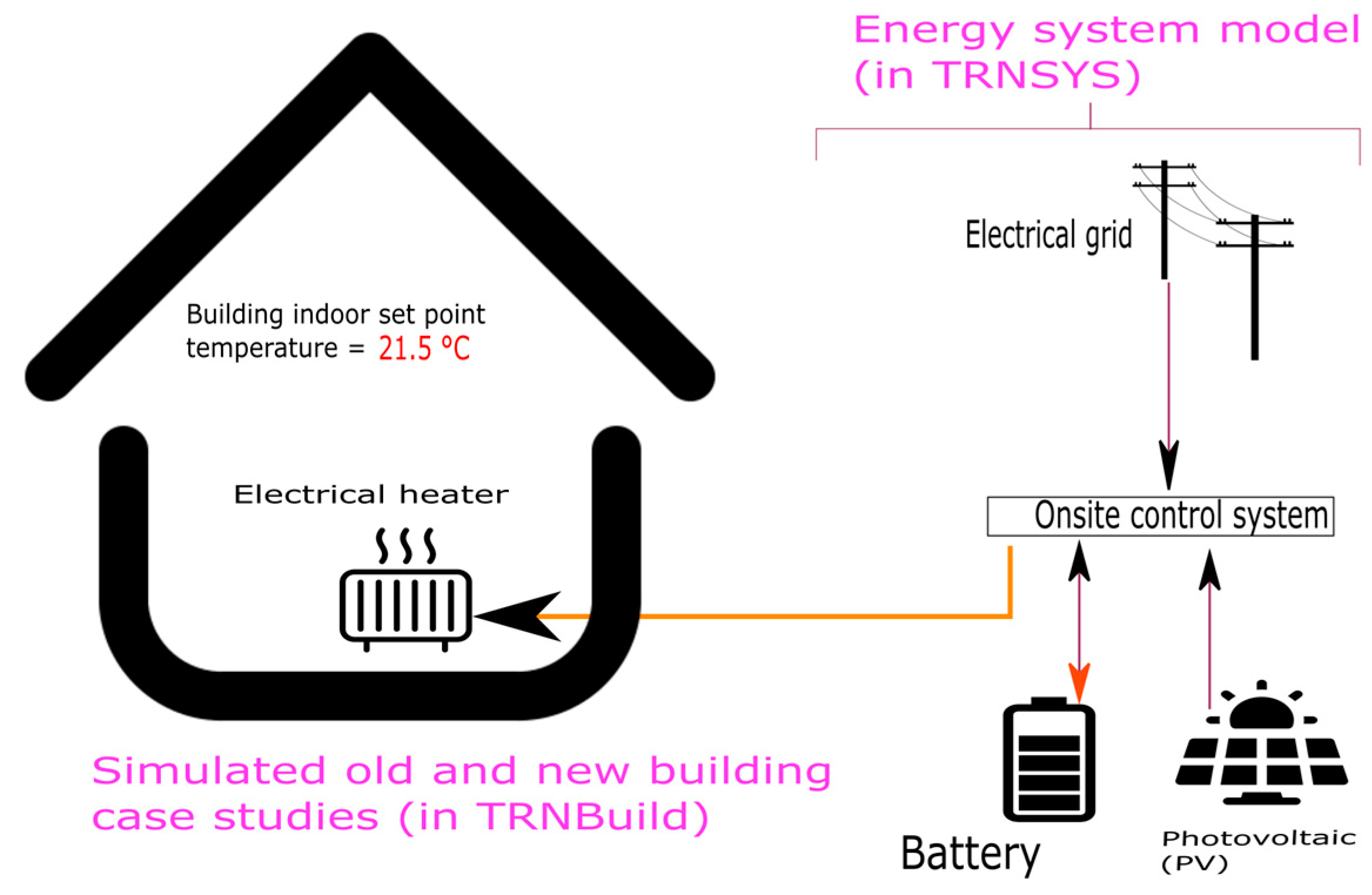
The future buildings and society need to be resilient. This article aims to propose a novel concept of the energy resilience framework and implement a color-based rating system to quantify and rate the energy resilience performance of buildings in Nordic climates. The objective is to conduct a comparative analysis between old (1970s) and new (2020s) single-family buildings integrated with renewable energy sources and storage, assessing their energy resilience performance for heating during power outages, under extreme and typical climatic conditions. The study utilizes dynamic simulation of the buildings and renewable energy systems, conducting parametric studies to calculate proposed resilience indicators and rate their resilience performance, employing both passive and active methods. The total costs of the design variables are also calculated for economic evaluation. Given the complexities arising from climate change, the article uses a simplified method to synthesize regional climate to consider extreme climate change impacts on energy resilience performance. For the old building lacking PV, the robustness duration increased from 1 h to 3 h, and the degree of disruption (DoD) varied from 0.545 to 0.3 in extreme cold to warm climate scenarios, with the higher DoD number indicating worse performance. The impact of the season within the same climate scenario is also evident, as the habitability and robustness durations increased during spring compared to winter. The resilience improved with PV and battery. The new building showed that the robustness duration increased from 3 to 15 h, habitability durations increased, and the DoD varied from 0.496 to 0.22 from extreme cold to warm climates without renewables and storage. With the integration of PV and battery, the new building was able to achieve a lower DoD and better performance with lower PV and battery capacity, compared to the old building. Furthermore, utilizing the color grading method (red to green), optimal technical solutions and corresponding design variables were identified for each building type and climate scenario that could support decision-making. The total cost of the optimal solutions varied, as new buildings required lower costs to reach optimal performance. However, for optimal resilience performance during extreme cold climate scenarios, higher costs are required for each building type. The proposed resilience framework, indicators, color grading system, and costing could potentially support improvements in building regulations, ensuring the development of optimally resilient buildings, particularly in the face of extreme climatic conditions.
寒冷気候における建物のエネルギーレジリエンスの包括的な定義と計画に向けて Towards Extensive Definition and Planning of Energy Resilience in Buildings in Cold Climate
Hassam ur Rehman,Mohamed Hamdy and Ala Hasan
Buildings Published: 17 May 2024
DOI:https://doi.org/10.3390/buildings14051453
Abstract
The transition towards a sustainable future requires the reliable performance of the building’s energy system in order for the building to be energy-resilient. “Energy resilient building in cold climates” is an emerging concept that defines the ability to maintain a minimum level of indoor air temperature and energy performance of the building and minimize the occupant’s health risk during a disruptive event of the grid’s power supply loss in a cold climate. The aim is to introduce an extensive definition of the energy resilience of buildings and apply it in case studies. This article first reviews the progress and provides an overview of the energy-resilient building concept. The review shows that most of the relevant focus is on short-term energy resilience, and the serious gap is related to long-term resilience in the context of cold regions. The article presents a basic definition of energy resilience of buildings, a systematic framework, and indicators for analyzing the energy resilience of buildings. Terms such as active and passive habitability, survivability, and adaptive habitable conditions are defined. The energy resilience indicators are applied on two simulated Finnish case studies, an old building and a new building. By systematic analysis, using the defined indicators and thresholds, the energy resilience performance of the buildings is calculated and compared. Depending on the type of the building, the results show that the robustness period is 11 h and 26 h for the old building and the new building, respectively. The old building failed to provide the habitability conditions. The impact of the event is 8.9 °C, minimum performance (Pmin) is 12.54 °C, and degree of disruption (DoD) is 0.300 for the old building. The speed of collapse (SoC) is 3.75 °C/h, and the speed of recovery (SoR) is 0.64 °C/h. On the other hand, the new building performed better such that the impact of the event is 4 °C, Pmin is 17.5 °C, and DoD is 0.138. The SoC is slow 3.2 °C/h and SoR is fast 0.80 °C/h for the new building. The results provide a pathway for improvements for long-term energy resilience. In conclusion, this work supports society and policy-makers to build a sustainable and resilient society.
寒冷地における新築・中古住宅のエネルギー柔軟性とレジリエンス:技術経済分析 Energy Flexibility and towards Resilience in New and Old Residential Houses in Cold Climates: A Techno-Economic Analysis
Hassam ur Rehman and Ala Hasan
Energies Published: 20 July 2023
DOI:https://doi.org/10.3390/en16145506
Abstract
One of the main sectors that contribute to climate change is the buildings sector. While nearly zero-energy buildings are becoming a new norm in many countries in the world, research is advancing towards energy flexibility and resilience to reach energy efficiency and sustainability goals. Combining the energy flexibility and energy resilience concept is rare. In this article, we aim to investigate the effect of energy efficiency in a new single-family building on the energy flexibility potential and resilience characteristics and compare these with those for an old building in the cold climate of Finland. These two objectives are dependent on the buildings’ respective thermal mass. The heat demands of the two buildings are compared. Their technical and economic performance are calculated to compare their flexibility and resilience characteristics. Dynamic simulation software is used to model the buildings. The results show that the old building has better flexibility and higher energy cost savings when including the energy conservation activation strategy. In the old building, savings can be around EUR 400 and flexibility factor can be around 24–52% depending on the activation duration and strategy. The new building, due to higher efficiency, may not provide higher energy cost savings, and the energy conservation activation strategy is better. In the new building, savings can be around EUR 70 and the flexibility factor reaches around 7–14% depending on the activation duration and strategy. The shifting efficiency of the new house is better compared to that of the old house due to its higher storage capacity. For energy resilience, the new building is shown to be better during power outages. The new building can be habitable for 17 h, while the old building can provide the same conditions for 3 h only. Therefore, it is essential to consider both energy flexibility and resilience as this can impact performance during the energy crisis.