
2025-09-09 早稲田大学
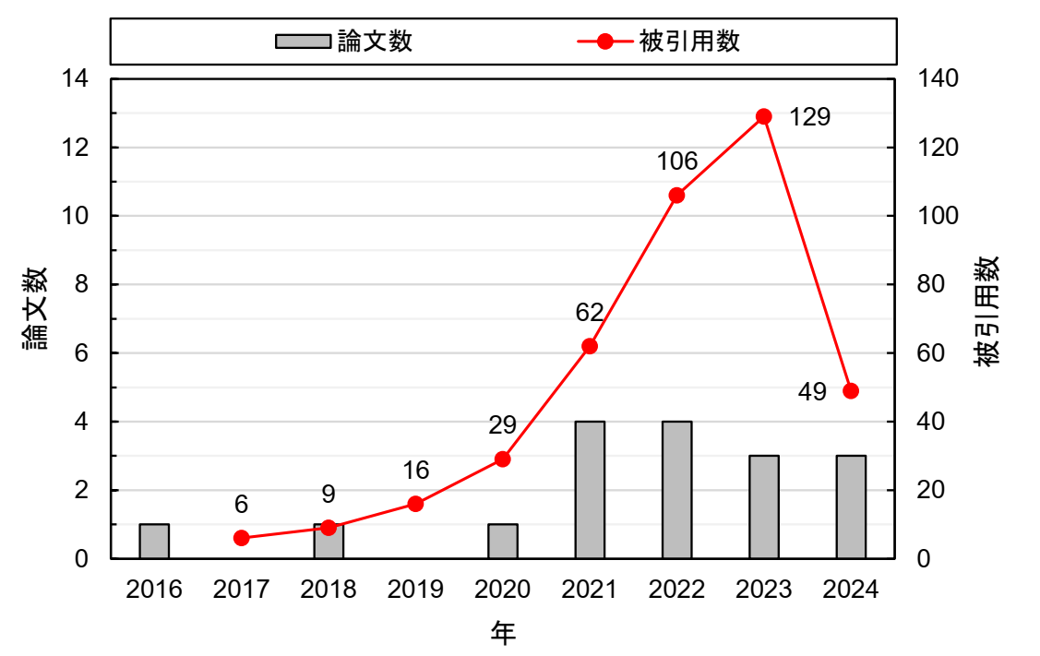
図1:睡眠中の換気と睡眠の質を同時に測定した論文数と被引用数の推移
2024年8月時点での状況を示しており、論文数が年々増加していることがわかる。
<関連情報>
- https://www.waseda.jp/inst/research/news/81991
- https://www.tandfonline.com/doi/full/10.1080/23744731.2025.2531317
寝室の換気と睡眠の質に関する新たな研究は、建築基準の見直しを提言している(ASHRAE 1837-RP) New research on bedroom ventilation and sleep quality suggests that building standards should be revisited (ASHRAE 1837-RP)
Mizuho Akimoto,Xiaojun Fan,Li Lan,Chandra Sekhar,Shin-ichi Tanabe,David P. Wyon & …
Science and Technology for the Built Environment Published:21 Jul 2025
DOI:https://doi.org/10.1080/23744731.2025.2531317
Abstract
We summarized studies examining the effects on sleep quality of poor bedroom air quality caused by inadequate ventilation. Two questions were addressed: 1) How does inadequate ventilation affect sleep? and 2) What ventilation rates are required to maintain bedroom air quality that does not reduce sleep quality? We identified and analyzed recent research studies that measured both bedroom ventilation and sleep quality. Our findings suggest that currently prescribed minimum ventilation rates for residential environments may provide insufficient ventilation for bedrooms and may thus lead to disturbed sleep. Specifically, the results suggest that absolute carbon dioxide (CO2) levels generated by sleeping occupants should, as a minimum, remain below 1,000 ppm, and preferably below 800 ppm; in this context, CO2 is an indicator of ventilation sufficiency, not a pollutant. To achieve these levels of CO2, bedroom outdoor air supply rates should be at least doubled compared to existing standards. While further research is needed to confirm these conclusions, the results provide strong justification for revising residential building ventilation standards and developing more energy-efficient solutions that will ensure compliance with the recommendations formulated in the present paper.
