
2026-10-16 日本原子力研究開発機構
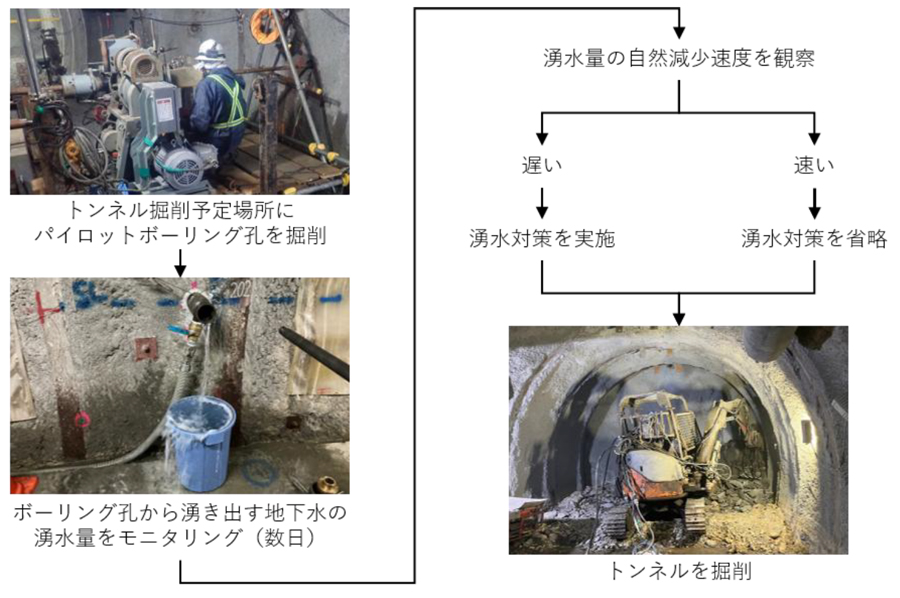
図 トンネル掘削における湧水量の予測手法のフロー図
<関連情報>
- https://www.jaea.go.jp/02/press2026/p26101602/
- https://link.springer.com/article/10.1007/s10064-026-05253-y
トンネル掘削中の断層帯や亀裂からの地下水流入量の自然減少率をリアルタイムで予測し、グラウト注入の実施の可否を判断するための応用 Real-time prediction of the natural decline rate of groundwater inflow from a fault zone or fractures during tunnel excavation and application to deciding on whether to implement grouting
Hiroaki Murakami, Eiichi Ishii & Keisuke Yagi
Bulletin of Engineering Geology and the Environment
Published:21 August 2026
DOI:https://doi.org/10.1007/s10064-026-05253-y
Abstract
Real-time prediction of the natural decline rate of groundwater inflow during tunnel excavation in faulted or fractured rock is crucial for deciding on whether to implement grouting. In this study, two pilot boreholes were drilled at the Horonobe Underground Research Laboratory, Japan, prior to the excavation of tunnels at depths of 350 and 500 m in faulted siliceous mudstone, and inflow from a fault zone (or fractures) in each borehole was analyzed using log–log plots of inflow rate versus elapsed time based on the hydraulic diffusion equation. The plots for both boreholes are characterized by a power law relationship. The plot for the tunnel at 500 m depth shows a steep slope indicating a rapid reduction in inflow. Accordingly, this tunnel was successfully excavated without pre-grouting. The results show that a log–log plot of inflow rate versus elapsed time, as obtained from a fault zone or fractures in a pilot borehole, can be used to rapidly predict the natural decline rate of inflow and determine whether grouting is needed for tunnel excavation.
