2026-03-25 インペリアル・カレッジ・ロンドン(ICL)
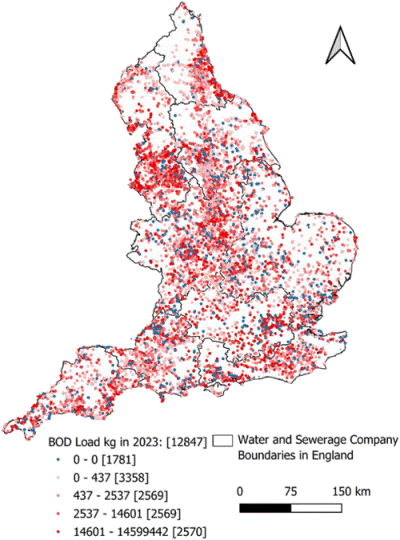
Location and distribution of combined sewer overflows (CSOs) BOD loads across England (2023)
<関連情報>
- https://www.imperial.ac.uk/news/articles/natural-sciences/environmental-policy/2026/sewage-overflows-may-pose-greater-threat-to-englands-rivers-than-previously-thought/
- https://pubs.rsc.org/en/content/articlelanding/2026/ew/d5ew00860c
合流式下水道越流による汚染負荷とイングランドの水域へのリスク:事象継続時間モニタリングデータと下水処理場からの排出許可との関連性 The pollution load of combined sewer overflows and risks to England’s waterbodies: relating event duration monitoring data to discharge consents from wastewater treatment works
Theodoros Giakoumis and Nikolaos Voulvoulis
Environmental Science: Water Research & Technology published:04 Mar 2026
DOI:https://doi.org/10.1039/D5EW00860C
Abstract
The increasing frequency of combined sewer overflows (CSOs) has heightened public concern, triggered government action, and driven water authorities worldwide to commit to major infrastructure upgrades. In England, the installation of event duration monitors (EDMs) has revealed how often and for how long spills occur annually, discharging untreated or diluted sewage to the receiving environment. However, overflow frequency and duration are poor proxies for pollution loads or ecological risk. This study provides the first national estimation of pollution loads from individual CSOs and the risks they pose to receiving waterbodies, drawing on permitted effluent limits from connected wastewater treatment works (WWTWs) and receiving waterbody characteristics. A source–pathway–receptor framework is used to classify risk across England’s wastewater systems in relation to CSO discharges and their impacts. The findings challenge the Environment Agency’s position that CSOs are not a primary driver of waterbody status failure, indicating their ecological impacts may be underestimated. For 2023, estimated aggregated CSO loads frequently surpassed those from the effluents of their WWTWs, with affected waterbodies receiving loads from CSOs four times higher for BOD and double for suspended solids. While nutrient loads exhibit lower relative contributions, the presence of wastewater systems where CSO loads equal or exceed treated effluent loads demonstrates that nutrient management strategies focusing solely on WWTWs risk overlooking a critical source. The study demonstrates how a systems approach integrating all available data, can strengthen evidence-based policy making, and support water companies in prioritising investments that can deliver measurable environmental improvements.