2026-03-24 早稲田大学
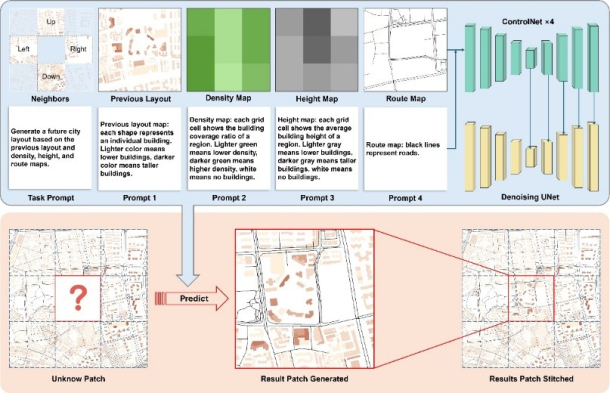
図1.生成AIによる都市将来予測の仕組み(MMCN)
<関連情報>
- https://www.waseda.jp/inst/research/news/83849
- https://scixplorer.org/abs/2026SusCS.14107272D/abstract
AIを活用した都市進化予測:持続可能な開発計画のための、メモリを考慮した統一的な多条件生成フレームワーク
AI-driven urban evolution forecasting: A unified memory-aware multi-conditional generation framework for sustainable development planning
Du, Xusheng;Li, Chengyuan;Li, Qingpeng;Lu, Yuxin;Xu, Yimeng;Zhang, Ye;Xu, Zhen;Xie, Haoran
Sustainable Cities and Society Published:May 2026
DOI:https://scixplorer.org/link_gateway/2026SusCS.14107272D/doi:10.1016/j.scs.2026.107272
Sustainable urban development requires predictive models that can comprehensively integrate multiple interdependent factors such as building density, height distribution, transportation networks, and historical evolution to support evidence-based planning. However, existing AI-based generative models cannot effectively integrate these factors, resulting in fragmented predictions that fail to support comprehensive urban planning strategies. To solve these issues, we propose MMCN (Memory-aware Multi-Conditional generation Network), an AI-driven framework that enables planners to forecast urban layout evolution by comprehensively modeling the complex interactions among multiple urban development factors. MMCN addresses three critical planning challenges through technical innovations: (1) a multi-conditional control architecture that processes building density, height, and transportation factors as interconnected elements influencing sustainable urban form; (2) a spatial continuity mechanism that ensures generated layouts maintain regional coherence; and (3) a temporal consistency framework that leverages historical layout patterns to capture long-term evolution trends. Using a comprehensive urban evolution dataset of Shenzhen, we demonstrate that MMCN substantially improves forecasting accuracy and spatial coherence, achieving an SSIM of 0.885 and a Boundary IoU of 0.642, significantly outperforming all baseline models. This work provides technical support for urban planning practitioners in sustainable development scenario analysis, enabling the formulation of long-term planning decisions that can balance urban growth with sustainability objectives and support the achievement of sustainable urban development goals.