2026-03-19 京都大学
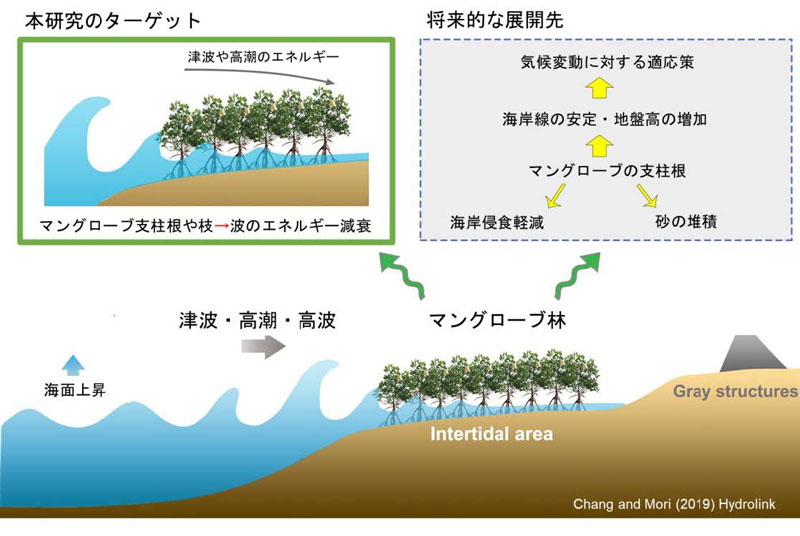
マングローブ減災効果の概念図
<関連情報>
- https://www.kyoto-u.ac.jp/ja/research-news/2026-03-19-1
- https://www.kyoto-u.ac.jp/sites/default/files/2026-03/web_2603_Mori-3af78df68c2546d258d6e282aa028f7a.pdf
- https://agupubs.onlinelibrary.wiley.com/doi/10.1029/2025JC022836
Rhizophora apiculataマングローブによる波浪減衰の調査:実験室実験とブシネスクモデルの組み合わせ Investigation of Wave Attenuation by Rhizophora apiculata Mangroves: Coupled Laboratory Experiments and Boussinesq Modeling
Yu-Lin Tsai, Che-Wei Chang, Nobuhito Mori
Journal of Geophysical Research: Oceans Published: 05 March 2026
DOI:https://doi.org/10.1029/2025JC022836
Abstract
Mangrove forests provide effective coastal protection by attenuating wave energy, yet quantifying wave-vegetation interactions remains challenging due to vertically heterogeneous root structures and variable submergence conditions. This study advances phase-resolving wave–vegetation modeling by integrating realistic, depth-dependent Rhizophora apiculata root morphology into a fully nonlinear Boussinesq-type model. A new vegetation module was developed and implemented in the model, allowing vertically varying projected area and submerged volume to dynamically respond to changing water levels. Unlike previous studies that typically represent vegetation using simplified cylinders, the present framework provides a physically consistent representation of how changing submergence modifies hydrodynamic resistance. Two parameterization approaches are examined: (a) laboratory-derived constant drag and inertia coefficients (CD-Lab;CM-Lab ) obtained from direct force measurements, and (b) empirical relations (CD-Re;CM-KC ) expressed as functions of Reynolds and Keulegan-Carpenter numbers, which introduce spatial and temporal variability. Model–data comparisons demonstrate that both schemes generally reproduce observed attenuation trends across different submergence conditions, but also reveal that transitional (near-full) submergence constitutes a distinct hydrodynamic regime, where submergence-independent empirical coefficients (CD-Re;CM-KC ) systematically underpredict wave damping by 5%–30%. Applying submergence-dependent, depth-specific parameterizations significantly improves agreement with laboratory measurements, particularly in the transitional regime. In this regime, only part of the root system is submerged, and flow blockage varies strongly with depth, limiting the applicability of submergence-independent empirical formulations. These findings indicate the importance of accounting for realistic vertical root geometry and submergence-sensitive resistance when modeling mangrove-induced wave attenuation.
Plain Language Summary
Mangrove forests can reduce wave energy and help protect our coastlines. However, predicting their effectiveness remains difficult because their complex root systems and changing water levels strongly influence how waves interact with mangroves. In this study, we combined laboratory experiments with a physics-based wave model to examine how wave energy is reduced by Rhizophora apiculata mangroves. We developed a new vegetation module that incorporates the vertical structure of mangrove roots, allowing the model to account for how different parts of the root system are submerged as water levels change. We tested two approaches for representing mangrove-induced effects on waves: one based on forces measured directly in laboratory experiments, and another using empirical formulas based on flow parameters. Both approaches captured overall wave energy reduction, but clear differences emerged when the roots were nearly—but not fully—submerged. Under these conditions, the empirical formulas consistently underpredicted wave energy loss because they did not fully capture depth-varying resistance when only part of the root system was underwater. These results show that wave damping by mangroves depends strongly on water depth and root structure, and that accounting for changing root submergence is important for predicting their coastal protection effectiveness.