2026-03-09 カリフォルニア大学リバーサイド校(UCR)
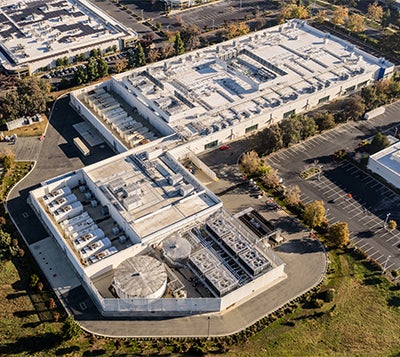
Data Center in Newark, Calif. (Getty Images)
<関連情報>
- https://news.ucr.edu/articles/2026/03/09/data-center-water-spikes-could-cost-billions
- https://arxiv.org/abs/2603.02705
小さなボトル、大きなパイプ:データセンターが公共水道システムに与える影響の定量化と対処 Small Bottle, Big Pipe: Quantifying and Addressing the Impact of Data Centers on Public Water Systems
Yuelin Han, Pengfei Li, Adam Wierman, Shaolei Ren
arXiv Submitted on 3 Mar 2026
DOI:https://doi.org/10.48550/arXiv.2603.02705
Abstract
Water is a critical resource for data centers and an efficient means of cooling. However, meeting the growing water demand of data centers requires substantial peak water withdrawals, which many communities in the United States cannot supply, especially during the hottest days of the year. This largely overlooked water capacity constraint is emerging as a bottleneck for data centers and can force operators to rely on less efficient dry cooling, further stressing the power grid during summer peaks. In this paper, we focus on the direct water withdrawal of U.S. data centers for cooling and examine their impacts on public water systems. Our analysis indicates that, if the 2024 water use intensity persists, U.S. data centers could collectively require 697-1,451 million gallons per day (MGD) of new water capacity through 2030, comparable to New York City’s average daily supply of roughly 1,000 MGD. Under an optimistic scenario with a compound annual water use intensity reduction by 10%, the water capacity demand decreases to 227-604 MGD, although high-growth IT loads could still require enough capacity to hypothetically supply about half of New York City for most of the year. The total valuation of the new water capacity is on the order of $10 billion, reaching up to $58 billion in the high-growth case. These impacts are highly concentrated on communities hosting data centers. Finally, we provide recommendations to address the growing water capacity demand of U.S. data centers, including reporting peak water use, developing corporate-community partnerships, adopting a Water Capacity Neutral approach (colloquially “Pipe Neutral”) to allow host communities to retain limited water capacity resources, and implementing coordinated water-power planning to responsibly leverage water for peak power reduction and opportunistically utilize surplus power to mitigate impacts on public water systems.