2026-02-24 ヒューストン大学(UH)
<関連情報>
- https://www.uh.edu/news-events/stories/2026/february/recycling-e-waste-research.php
- https://www.nature.com/articles/s41598-025-27878-x
デュアルチャネル電子廃棄物サプライチェーンにおける競争と協力のゲーム理論的モデリングと最適化 Game theoretic modeling and optimization of competition and collaboration in dual channel electronic waste supply chains
Chuyue Wang,Jian Shi & Kailai Wang
Scientific Reports Published:03 December 2025
DOI:https://doi.org/10.1038/s41598-025-27878-x
Abstract
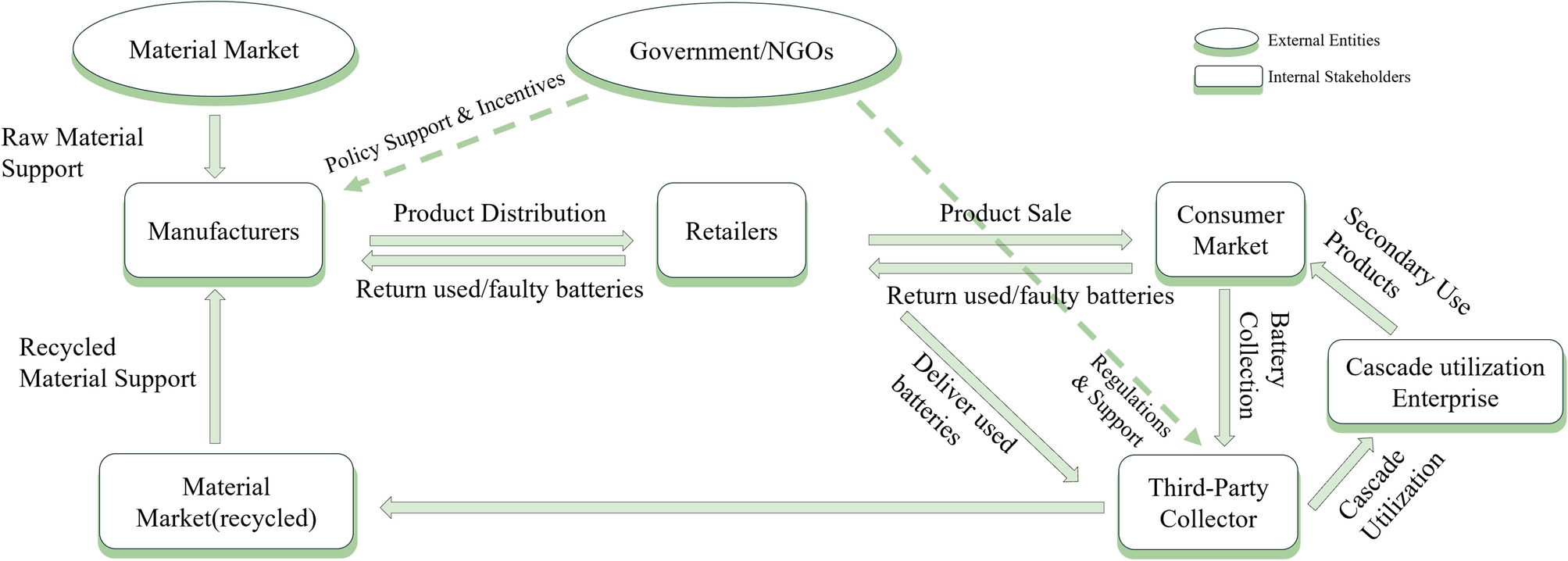
The rapid growth of electronic waste (e-waste) presents critical challenges for sustainable resource recovery and environmental protection. This study develops a dual-channel closed-loop supply chain (CLSC) model formulated as a hierarchical Stackelberg game, that integrates dynamic pricing and cost-sharing mechanisms to optimize both economic and environmental outcomes. The model explicitly captures strategic interactions between manufacturer-led and third-party recycling channels, accounting for consumer behavior, regulatory incentives, and market competition. Numerical simulations conducted (implemented over a four-iteration horizon using a commercial optimization solver) show that, relative to the baseline equilibrium, manufacturer profit increases from 11.6 thousand USD to 37.9 thousand USD (+226.8%), total recycled volume rises from 7,848 to 7,942 units (+1.2%), and collector profit nearly doubles under cost-sharing, enabling more equitable profit distribution. Furthermore, scenario-based simulations across Sub-Saharan Africa, high-income economies, and emerging Asian industrial countries reveal that infrastructure quality, policy intensity, and labor costs critically shape recycling efficiency and profit allocation. These findings demonstrate that subsidies alone are insufficient to ensure system efficiency. Instead, coordinated strategies that integrate internal incentive alignment with context-sensitive policy support are required. Overall, this study offers a robust framework for designing resilient, efficient, and regionally adaptable e-waste management systems.