2026-02-16 筑波大学
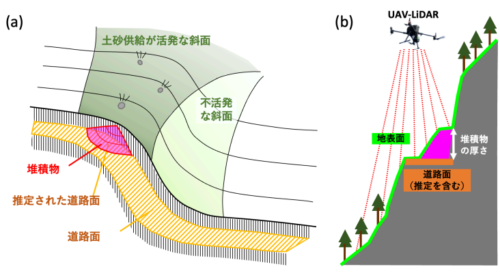
図1 本研究での測量に関する概要左図(a)は道路の模式図であり、元の道路面に対して、堆積が生じている状況を模式的に示している。今回の分析では道路背後の地形条件に応じて、道路区間を複数に分割した。右図(b)では UAV-LiDAR を用いて道路面周辺の測量を行っている様子を示している。堆積物に隠れている元の道路面の高さを、周辺の堆積物に覆われていない道路面の標高から内挿して推定した。
<関連情報>
- https://www.tsukuba.ac.jp/journal/biology-environment/20260216140000.html
- https://www.tsukuba.ac.jp/journal/pdf/p20260216140000.pdf
- https://www.sciencedirect.com/science/article/abs/pii/S0169555X2600036X
廃道は瓦礫の堆積場となる:UAV-LiDAR DEMに基づく急斜面からの瓦礫供給率の推定 An abandoned road as a debris trap: Estimating debris-supply rate from steep slopes based on UAV–LiDAR DEMs
Shunsuke Harada, Tsuyoshi Hattanji, Takuro Ogura, Yuichi, S. Hayakawa
Geomorphology Available online: 4 February 2026
DOI:https://doi.org/10.1016/j.geomorph.2026.110193
Highlights
- Volume of debris deposits on an abandoned road were analyzed considering the road as a trap.
- Rockfalls accumulate rapidly on road segments with steep (> 45°) convergent contributing areas.
- UAV LiDAR survey on abandoned roads enables estimation of debris-supply rate into headwater valleys.
Abstract
The debris-supply rate is an important factor that controls the frequency of debris flows in steep headwater streams. However, the decadal-scale observation of debris supply has been technically difficult. This study proposes a new method using abandoned roads to estimate debris-supply rate by rockfall into debris-flow prone channels for a decadal timescale. Debris deposits on a road that had been abandoned for 31 years were surveyed using an unmanned aerial vehicle (UAV) with light detection and ranging (LiDAR), considering the abandoned road as a trap. The surveyed road is located in a high mountain range in central Japan, where rockfalls and debris flows are active with a high uplift rate of approximately 4 mm/yr. The 4.75-km long abandoned road was divided into 96 road segments, and the debris deposit forms on these segments were classified into several types depending on geomorphic processes and its activity. Debris accumulates rapidly due to rockfalls on road segments with mean slopes of >45° and a contributing area > 2000 m2. Debris transport by water flow or debris flow were common at segments with a large contributing area > 26,000 m2. The estimated volume of debris supply from slopes to a given source area of debris flow (contributing area of 10,000–20,000 m2) is 70–93 m3/yr, and this value reveals that runoff-generated debris flows may occur every few decades. Our method using abandoned roads is useful to estimate debris-supply rate by rockfall into debris-flow prone channels for a decadal timescale.