2025-07-25 ノースカロライナ州立大学(NCState)
<関連情報>
- https://news.ncsu.edu/2025/07/building-a-high-rise-out-of-wood-cross-laminated-timber-could-make-it-possible/
- https://www.nature.com/articles/s41467-025-60245-y
大量木材製品の全球的な土地と炭素への影響 Global land and carbon consequences of mass timber products
Kai Lan,Alice Favero,Yuan Yao,Robert O. Mendelsohn & Hannah Szu-Han Wang
Nature Communication Published:26 May 2025
DOI:https://doi.org/10.1038/s41467-025-60245-y
Abstract
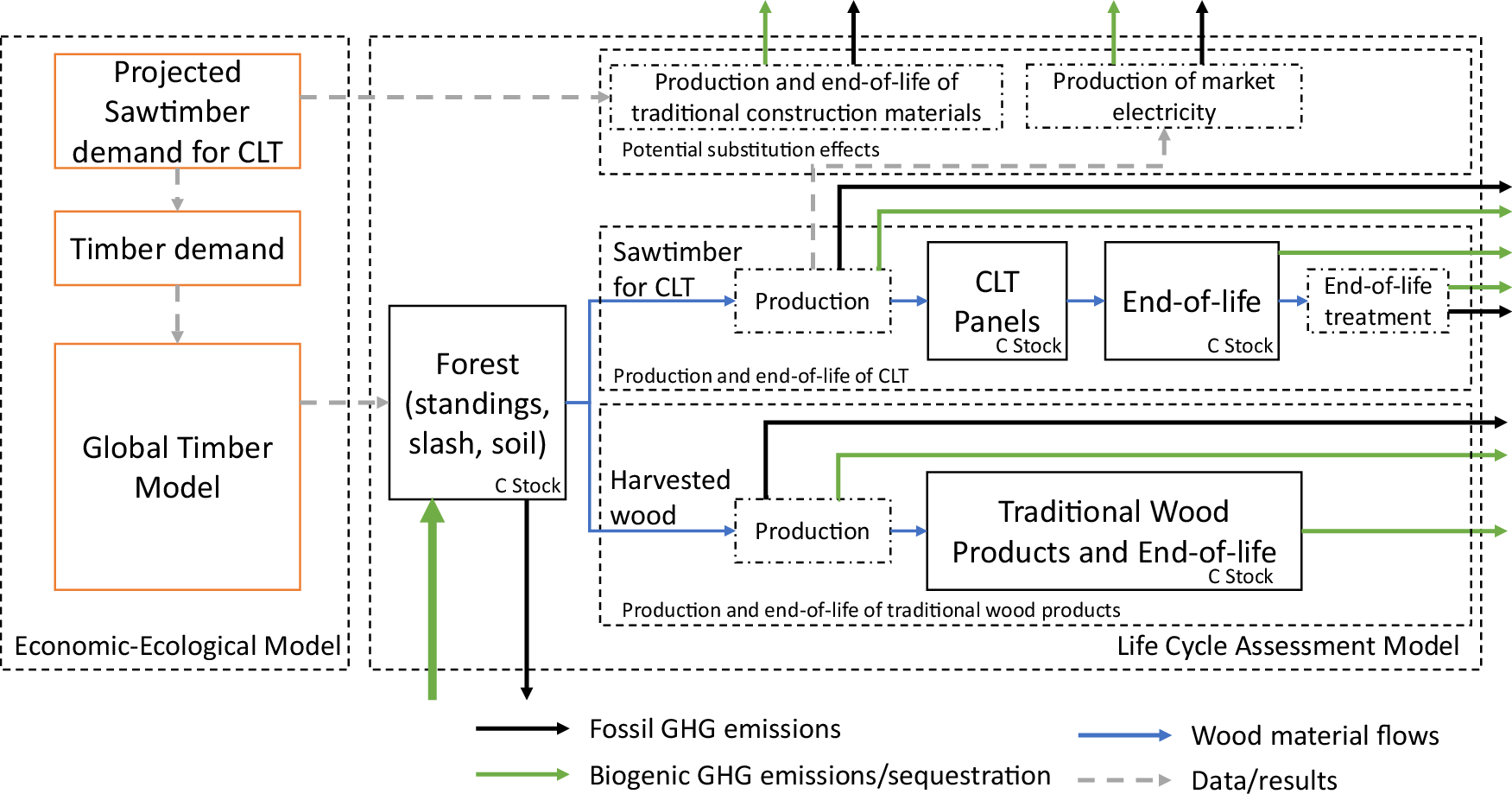
Mass timber products can reduce greenhouse gas emissions by replacing steel and cement. However, the increase in wood demand raises wood prices, and the environmental consequences of these market changes are unclear. Here we investigate the global carbon and land use impacts of adopting mass timber products, focusing on cross-laminated timber as a case study. Our results show that higher wood prices reduce the production of traditional wood products but expand productive forestland by 30.7–36.5 million hectares from 2020 to 2100 and lead to more intensive forest management. If the cumulative global cross-laminated timber production reaches 3.6 to 9.6 billion m3 by 2100, long-term carbon storage can increase by 20.3–25.2 GtCO2e, primarily in forests (16.1–17.7 GtCO2e) and in cross-laminated timber panels (4.1–8.1 GtCO2e). Including emission reductions from steel, cement, and traditional wood products, the net reduction of life-cycle greenhouse gas emissions will be 25.6–39.0 GtCO2e.