2026-08-12 ピッツバーグ大学
<関連情報>
- https://news.engineering.pitt.edu/wholl-stop-the-rain-and-reuse-it/
- https://www.nature.com/articles/s41545-026-00585-4
流出水から循環型資源へ:都市雨水システムにおけるコスト、エネルギー、および温室効果ガス性能のための統合最適化フレームワーク From runoff to circular resource: an integrated optimization framework for cost, energy, and GHG performance in urban stormwater systems
Ahteshamul Haq,SriGanesh V. Pennathur,Sarah Jane Haig & Vikas Khanna
npj Clean Water Published:13 May 2026
DOI:https://doi.org/10.1038/s41545-026-00585-4
Abstract
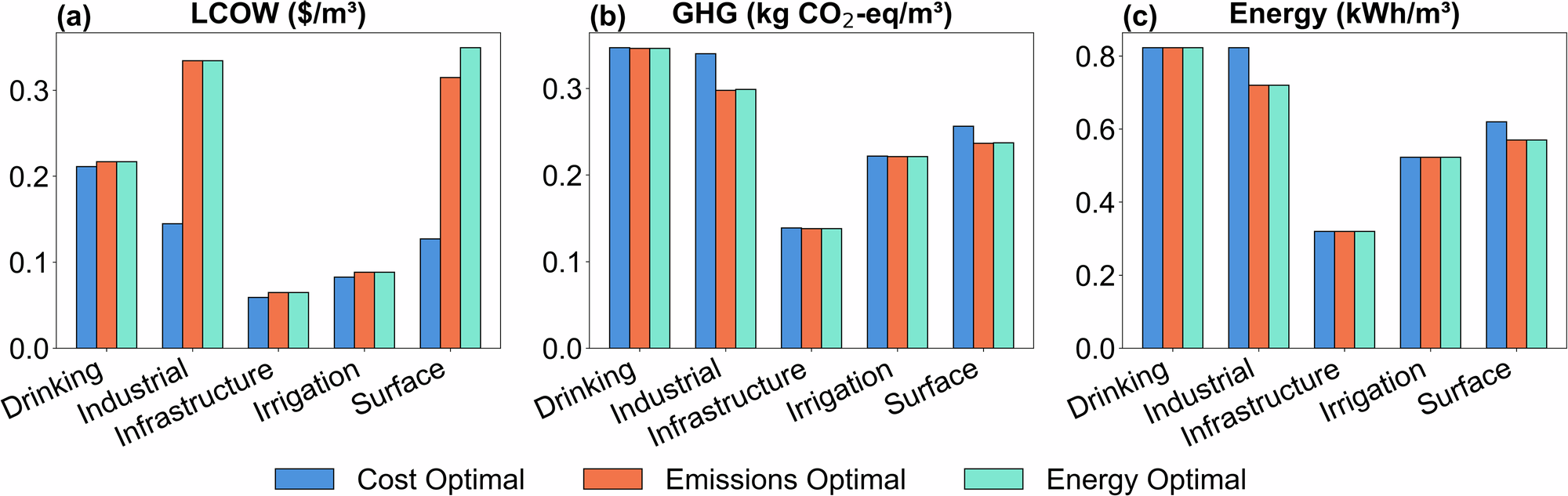
Stormwater reuse is a key strategy for advancing integrated urban water management under the One Water framework, yet identifying sustainable treatment trains remains challenging due to trade-offs among cost, energy, and emissions. This study presents an integrated techno-economic and environmental optimization framework to identify optimal end-use-specific stormwater treatment systems for the eastern United States. A mixed-integer nonlinear programming superstructure integrates cost, energy, and life cycle greenhouse gas emissions data for a suite of technologies—including coagulation, sedimentation, constructed wetlands, filtration, membranes, and disinfection—across five end uses: drinking, industrial, irrigation, infrastructure, and surface-water recharge. Results reveal that cost-optimal treatment trains generally align with emission-optimal trains for drinking water, irrigation, and infrastructure, as treatment flexibility is constrained by either stringent (drinking water) or lenient (irrigation, infrastructure) quality requirements that limit flexibility. Industrial and surface-water recharge pathways exhibit greater differentiation among objectives, reflecting trade-offs between costs and emissions. Under typical influent conditions, levelized costs range from $0.06–$0.20 m⁻³, life cycle GHG emissions from 0.14–0.35 kg CO₂-eq m⁻³, and energy consumption from 0.3–0.8 kWh m⁻³, with all metrics increasing alongside treatment complexity. Scaling analysis indicates diminishing cost benefits beyond ~50 MGD, while sensitivity analysis highlights annual operating days and electricity price as dominant uncertainty drivers. This framework provides a transferable decision-support tool for designing resilient, low-emission, and economically viable stormwater reuse systems tailored to diverse end uses.