2026-03-25 米国国立再生可能エネルギー研究所(NREL)
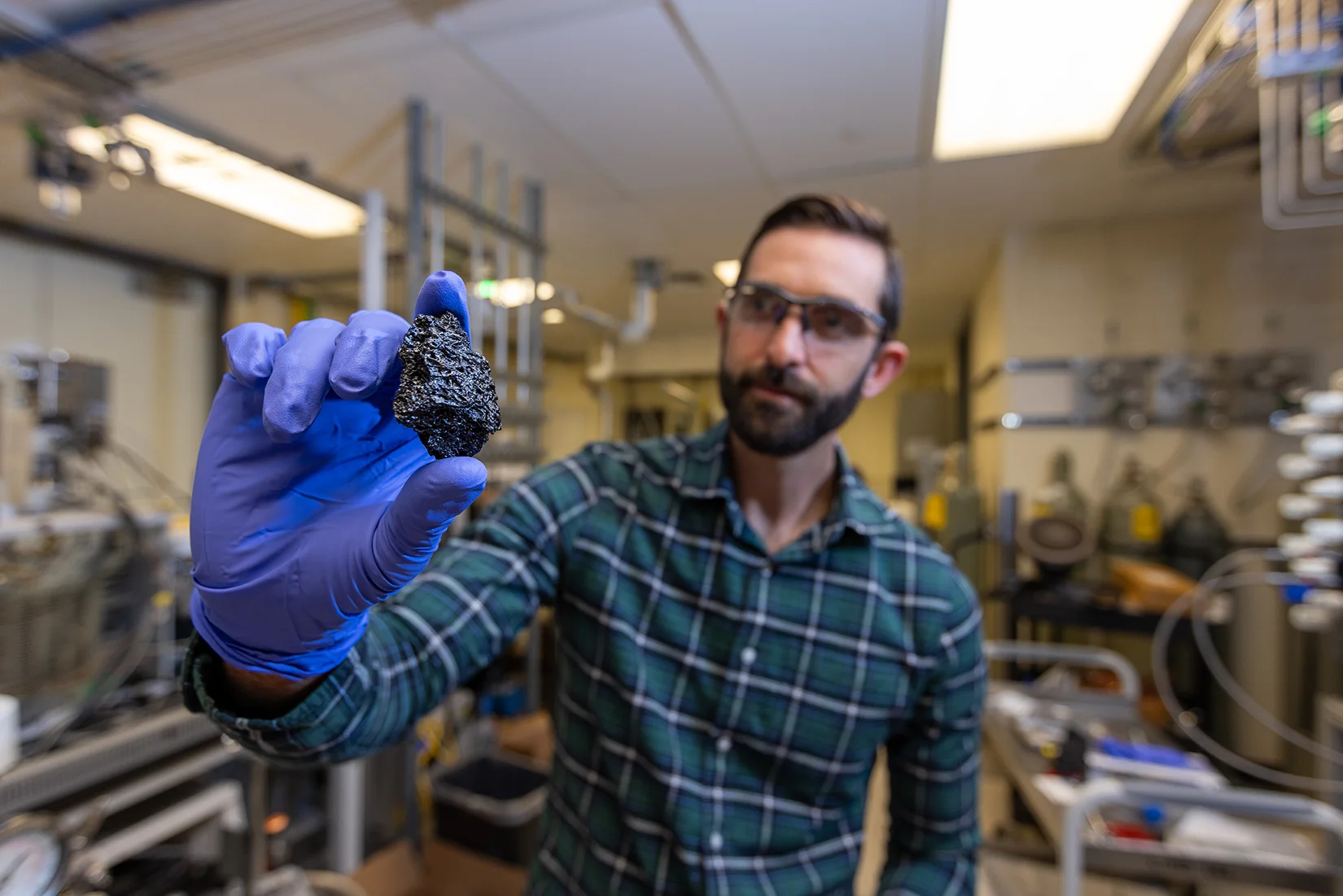
NLR researchers have developed two novel pathways using fast pyrolysis to create bio-based graphite. The process, which leverages waste materials, could bolster American graphite production and secure a critical supply chain for battery and steel manufacturing. Photo by Agata Bogucka, National Laboratory of the Rockies
<関連情報>
- https://www.nlr.gov/news/detail/program/2026/turning-biomass-into-graphite-could-help-secure-us-critical-mineral-supply
- https://chemistry-europe.onlinelibrary.wiley.com/doi/10.1002/cssc.202402509
バイオ精製残渣から得られる持続可能な黒鉛とジェット燃料 Sustainable Graphite and Jet Fuel from Biorefinery Residue
Lillian Lower, Steven M. Rowland, Michael Regula, Kristiina Iisa, Zachary A. Combs, Sunkyu Park, Tijmen Vries, Ton Vries, Mark R. Nimlos, William Joe Sagues
ChemSusChem Published: 28 February 2025
DOI:https://doi.org/10.1002/cssc.202402509
Abstract
Battery-grade graphite and aviation fuel are traditionally produced from non-renewable, fossil carbon feedstocks and result in substantial greenhouse gas emissions. Biomass holds exciting potential as a renewable and sustainable feedstock for the production of graphite and aviation fuel, but challenges exist including the necessity of a catalyst when producing graphite and low selectivity when producing aviation fuel. A process to convert a biomass-derived feedstock into graphite without the use of a catalyst and fuels with high selectivity towards sustainable aviation fuel (SAF) is innovated. Heavy bio-oil undergoes a conversion process similar to the commercial production of synthetic graphite including coking at 500 °C, calcination at 1000 °C, and graphitization at 2800 °C. The resulting biographite exhibits excellent performance in lithium-ion battery configurations with specific capacity of ~330 mAh g−1 and a 96.8 % capacity rebound after high rate cycling. The liquid hydrocarbon co-product from coking is suitable for hydrotreating into SAF. The aviation fuel fraction (70 wt % of the fuel produced) meets ASTM standards and is composed primarily of cycloalkanes (~80 wt %) which improves energy density compared to paraffins produced by other SAF pathways and may replace aromatics for elastomer swelling in traditional jet fuel with less soot production.