2025-12-09 マサチューセッツ工科大学 (MIT)
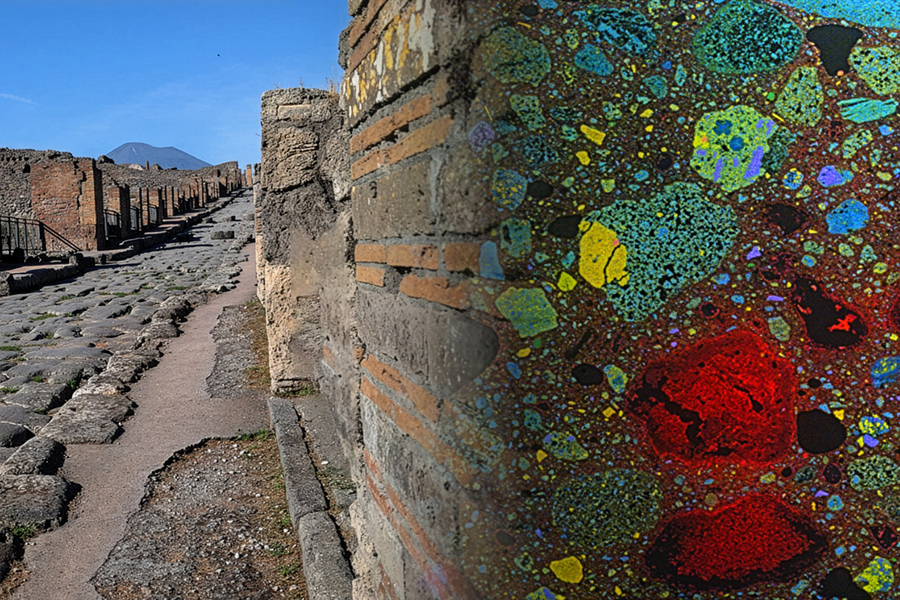 <関連情報>
- https://news.mit.edu/2025/pompeii-offers-insights-ancient-roman-building-technology-1209
- https://www.nature.com/articles/s41467-025-66634-7
- https://www.science.org/doi/10.1126/sciadv.add1602
未完成のポンペイの建設現場から古代ローマの建築技術が明らかになった An unfinished Pompeian construction site reveals ancient Roman building technology
Ellie Vaserman,James C. Weaver,Claire Hayhow,Kristin Bergmann,Celestino Grifa,Roberto Scalesse,Valeria Amoretti,Antonino Russo,Gennaro Iovino,Gabriel Zuchtriegel & Admir Masic
Nature Communications Published:09 December 2025
DOI:https://doi.org/10.1038/s41467-025-66634-7
Abstract
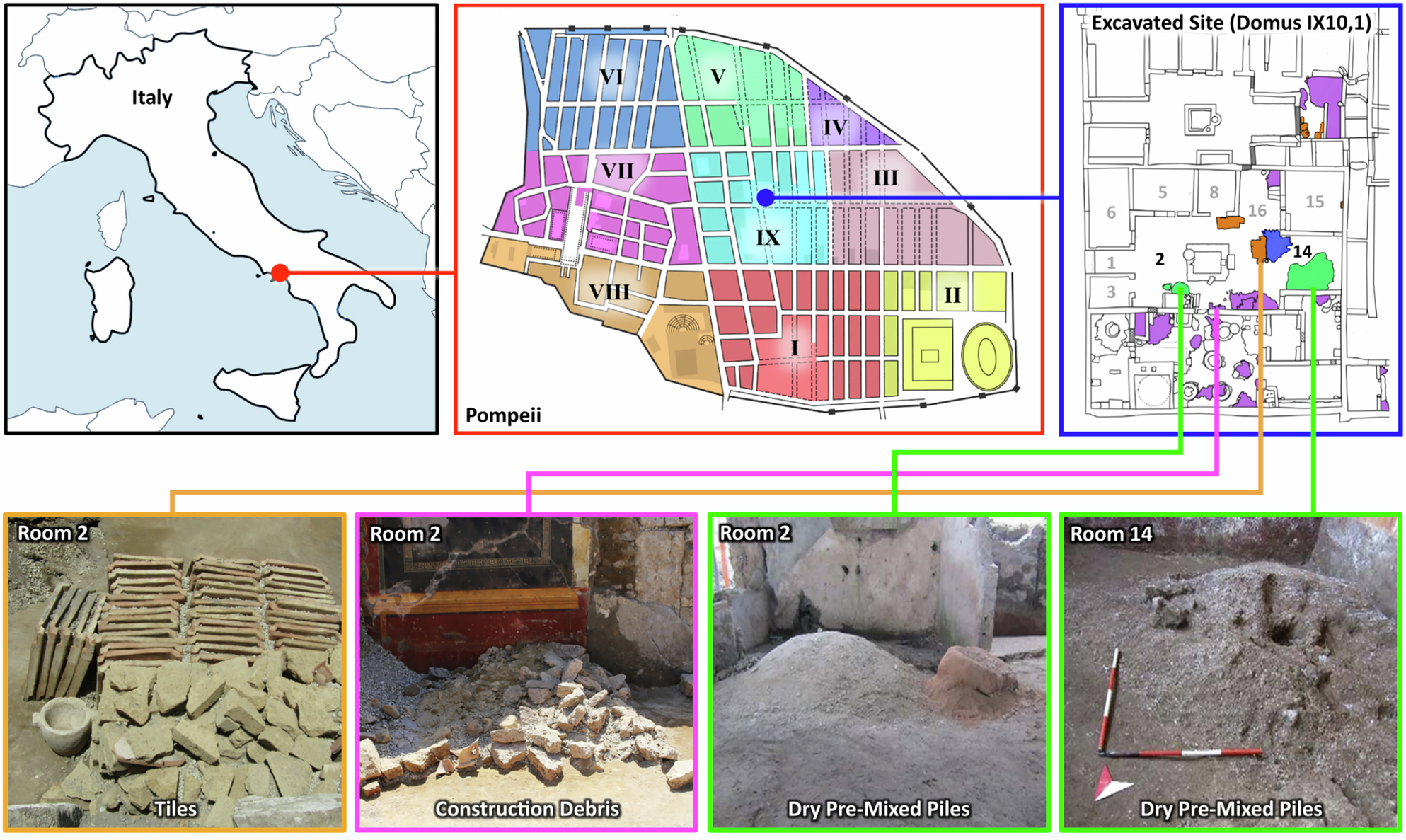
Recent excavations at Pompeii’s Regio IX have uncovered an intact ancient construction site, offering insights into Roman building techniques at the time of the eruption of Mount Vesuvius in 79 CE. Microstructural and chemical analysis of materials collected from previously constructed walls, walls under construction, and adjacent dry, raw material piles show unequivocally how quicklime was pre-mixed with dry pozzolan before adding water in the creation of Roman concrete. This construction method, also known as hot mixing, results in an exothermic reaction within the mortar and the formation of lime clasts, key contributors to the self-healing and post-pozzolanic reactivity of hydraulic mortars. The analysis of reaction rims around volcanic aggregates demonstrate aggregate/matrix interfacial remodeling, where calcium ions originating from the dissolution of lime clasts diffuse and remineralize, producing amorphous phases and various polymorphs of calcium carbonate (including calcite and aragonite). Furthermore, the parallel discovery of masonry materials and tools permits elucidation of the entire construction workflow, including the steps required to process binding mortars and larger aggregates (caementa). These findings advance our understanding of ancient Roman construction and long-term material evolution, providing a scientific basis for developing more durable and sustainable concretes and restoration materials inspired by ancient practices.
熱間混合:古代ローマのコンクリートの耐久性に関するメカニズムの洞察 Hot mixing: Mechanistic insights into the durability of ancient Roman concrete
Linda M. Seymour, Janille Maragh, Paolo Sabatini, Michel Di Tommaso, […] , and Admir Masic
Science Advances Published:6 Jan 2023
DOI:https://doi.org/10.1126/sciadv.add1602
Abstract
Ancient Roman concretes have survived millennia, but mechanistic insights into their durability remain an enigma. Here, we use a multiscale correlative elemental and chemical mapping approach to investigating relict lime clasts, a ubiquitous and conspicuous mineral component associated with ancient Roman mortars. Together, these analyses provide new insights into mortar preparation methodologies and provide evidence that the Romans employed hot mixing, using quicklime in conjunction with, or instead of, slaked lime, to create an environment where high surface area aggregate-scale lime clasts are retained within the mortar matrix. Inspired by these findings, we propose that these macroscopic inclusions might serve as critical sources of reactive calcium for long-term pore and crack-filling or post-pozzolanic reactivity within the cementitious constructs. The subsequent development and testing of modern lime clast–containing cementitious mixtures demonstrate their self-healing potential, thus paving the way for the development of more durable, resilient, and sustainable concrete formulations.