2025-09-29 米国国立標準技術研究所(NIST)
Web要約 の発言:
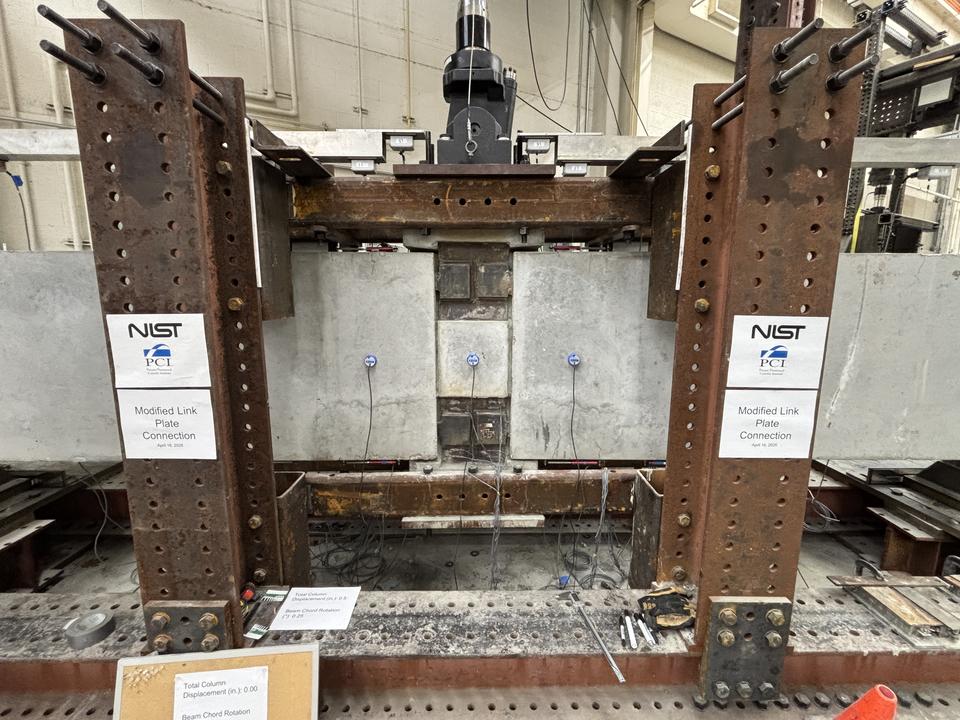
This is one of the five new connections designed by NIST engineers. Four dumbbell-shaped “link plates” each have one end embedded in a concrete beam. The other end is welded onto a central column. The dumbbell shape creates intentional weak points where the steel is free to stretch. Engineers call these weak points “structural fuses” because like an electrical fuse, they are designed to break first, preserving the rest of the structure. Credit: M. Ammons/NIST
<関連情報>
- https://www.nist.gov/news-events/news/2025/09/nist-engineers-design-5-new-ways-connect-concrete-pieces-more-resilient
- https://nvlpubs.nist.gov/nistpubs/TechnicalNotes/NIST.TN.2348B.pdf
柱撤去下における新たなプレキャストコンクリートモーメント接合部 New Precast Concrete Moment Connections under a Column Removal Scenario
Malcolm Ammons, Jonathan Weigand, Travis Thonstad
NIST Technical Note 2148B Published:September 2025
DOI:https://doi.org/10.6028/NIST.TN.2348B
Abstract
This technical note presents an experimental investigation of the performance of five novel precast concrete moment-resisting connections subjected to a column-removal scenario. The objectives of the investigation were 1) to characterize the behavior and failure modes of the connection assemblies and 2) assess their viability for use in precast concrete construction to achieve robust performance against disproportionate collapse. The tested assemblies were derived at a five-eighth scale from a 10-story prototype building and consisted of two half-span spandrel beams connected to a central column. The assemblies were designed specifically for moments induced from the loss of an exterior column in the prototype building. A capacity design approach was taken to concentrate inelastic action in designated components at the beam-to-column interface. Each assembly was subjected to monotonically increasing vertical displacement applied to the unsupported column until connection failure. The assemblies were extensively instrumented to measure the vertical force applied to the assembly, displacement at different locations along the beams and column, in-plane rotations of the precast concrete components, and strains in the reinforcing bars and steel connection components.
All the assemblies failed as was intended by design, with rotational deformations concentrating in designated ductile components until their eventual failure. A computational methodology was used in conjunction with the experimental results to evaluate the structural robustness of the assemblies against sudden column loss. All the assemblies were shown capable of withstanding loads greater than the applicable gravity loading that they would need to sustain to prevent collapse under sudden column loss. Although the threaded rod connection assembly’s connections were the easiest to make in a laboratory setting, all the connection concepts were proven viable for use in precast concrete construction, with each concept having unique advantages and disadvantages.