2025-07-23 レンセラー工科大学(RPI)
 <関連情報>
- https://news.rpi.edu/2025/07/23/universal-law-governs-urban-transport-adaptation-extreme-floods
- https://www.nature.com/articles/s41893-025-01575-z
- https://www.pnas.org/doi/10.1073/pnas.2203042119
- https://www.nature.com/articles/nature16948
極端な洪水に対する複合輸送ネットワークの適応能力 Adaptive capacity for multimodal transport network resilience to extreme floods
Chunhong Li,Weiping Wang,Albert Solé-Ribalta,Javier Borge-Holthoefer,Bin Jia,Zhiyuan Liu,Bin Yu,Ziyou Gao & Jianxi Gao
Nature Sustainability Published:25 June 2025
DOI:https://doi.org/10.1038/s41893-025-01575-z
Abstract
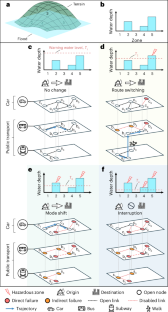
As extreme weather events enhanced by climate change pose challenges to the resilience of critical infrastructure, the ability to handle disruptions, avoid tipping points, adapt and transform in crises becomes essential. Despite advances in resilience research, there is a need to improve empirical evidence and mathematical models to quantify the systems’ adaptive capabilities to extreme climate-related phenomena, such as floods. This research fills this gap by integrating an agent-based multimodal traffic functional model with a compound failure model to provide valuable insights into adaptation patterns (that is, mode shift and route switching) and risk mitigation in response to flood-related disruptions. The proposed modelling approach not only quantifies the recovery and adaptive capacity against failures, going beyond traditional resilience analyses, but also unveils the key factors that drive adaptation of transportation to flood-induced disasters. These factors include variations in trip demand and network density, which together reveal a universal law of mode shift. The study provides valuable insights into the design of resilient and sustainable critical infrastructure systems, such as transportation, energy and communication systems capable of withstanding severe flood events while maintaining their functionality.
大規模危機に直面した際の人間の移動に関する時空間崩壊モデル A spatiotemporal decay model of human mobility when facing large-scale crises
Weiyu Li, Qi Wang , Yuanyuan Liu, +1 , and Jianxi Gao
Proceedings of the National Academy of Sciences Published:August 8, 2022
DOI:https://doi.org/10.1073/pnas.2203042119
Significance
Following large-scale extreme events—such as hurricanes, wildfires, and pandemics—changes in human movement patterns can vary dramatically from place to place and in the weeks and months following the event. Identifying patterns in spite of such variations across space and over time can help societies mount more effective responses. Our model uncovers that, across multiple types of events and despite their diversity and complexity, such changes follow a predictable hyperbolic pattern. The model can help understand and forecast movement patterns in future extreme events. It also uncovers hidden disparities in behavioral changes due to income inequality post large-scale crises.
Abstract
A common feature of large-scale extreme events, such as pandemics, wildfires, and major storms is that, despite their differences in etiology and duration, they significantly change routine human movement patterns. Such changes, which can be major or minor in size and duration and which differ across contexts, affect both the consequences of the events and the ability of governments to mount effective responses. Based on naturally tracked, anonymized mobility behavior from over 90 million people in the United States, we document these mobility differences in space and over time in six large-scale crises, including wildfires, major tropical storms, winter freeze and pandemics. We introduce a model that effectively captures the high-dimensional heterogeneity in human mobility changes following large-scale extreme events. Across five different metrics and regardless of spatial resolution, the changes in human mobility behavior exhibit a consistent hyperbolic decline, a pattern we characterize as “spatiotemporal decay.” When applied to the case of COVID-19, our model also uncovers significant disparities in mobility changes—individuals from wealthy areas not only reduce their mobility at higher rates at the start of the pandemic but also maintain the change longer. Residents from lower-income regions show a faster and greater hyperbolic decay, which we suggest may help account for different COVID-19 rates. Our model represents a powerful tool to understand and forecast mobility patterns post emergency, and thus to help produce more effective responses.
複雑なネットワークにおける普遍的な回復力パターン Universal resilience patterns in complex networks
Jianxi Gao,Baruch Barzel & Albert-László Barabási
Nature Published:17 February 2016
DOI:https://doi.org/10.1038/nature16948
An Author Correction to this article was published on 28 March 2019
An Erratum to this article was published on 04 May 2016
Abstract
Resilience, a system’s ability to adjust its activity to retain its basic functionality when errors, failures and environmental changes occur, is a defining property of many complex systems1. Despite widespread consequences for human health2, the economy3 and the environment4, events leading to loss of resilience—from cascading failures in technological systems5 to mass extinctions in ecological networks6—are rarely predictable and are often irreversible. These limitations are rooted in a theoretical gap: the current analytical framework of resilience is designed to treat low-dimensional models with a few interacting components7, and is unsuitable for multi-dimensional systems consisting of a large number of components that interact through a complex network. Here we bridge this theoretical gap by developing a set of analytical tools with which to identify the natural control and state parameters of a multi-dimensional complex system, helping us derive effective one-dimensional dynamics that accurately predict the system’s resilience. The proposed analytical framework allows us systematically to separate the roles of the system’s dynamics and topology, collapsing the behaviour of different networks onto a single universal resilience function. The analytical results unveil the network characteristics that can enhance or diminish resilience, offering ways to prevent the collapse of ecological, biological or economic systems, and guiding the design of technological systems resilient to both internal failures and environmental changes.