
2026-03-05 パデュー大学
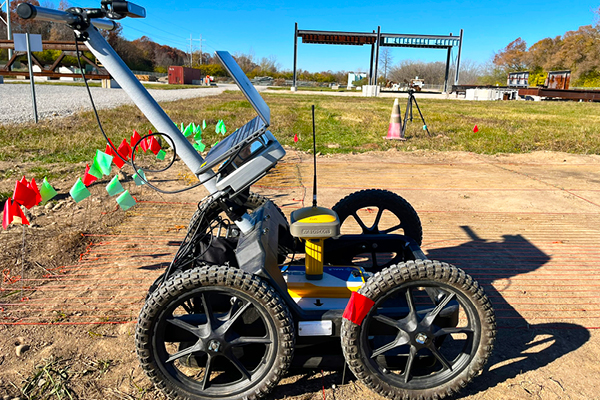
A rover equipped with a ground-penetrating radar system and global positioning system follows predefined grid lines as part of a field experiment conducted by Purdue researcher Hubo Cai and doctoral candidate Yuxi Zhang. (Purdue University photo/Yuxi Zhang)
<関連情報>
- https://www.purdue.edu/newsroom/2026/Q1/purdue-radar-technology-estimates-location-orientation-radius-of-underground-pipes/
- https://www.sciencedirect.com/science/article/abs/pii/S1474034625009863
GPRデータからの不確実性を考慮した地下パイプラインの位置特定と方向推定 Uncertainty-aware localization and orientation estimation of underground pipelines from GPR data
Yuxi Zhang, Hubo Cai
Advanced Engineering Informatics Available online: 22 November 2025
DOI:https://doi.org/10.1016/j.aei.2025.104093
Highlights
- A Bayesian framework was devised for reliable localization and orientation estimation of underground pipelines.
- A forward model incorporating domain knowledge was developed to predict wave travel times from reflections off 3D pipe geometries.
- The uncertainty quantification method was validated using both simulated and field datasets.
Abstract
The lack of accurate, complete, and reliable utility records leads to utility strikes and conflicts, causing significant financial loss and human injuries or fatalities every year. This study presents a framework for uncertainty-aware localization and orientation estimation of underground pipelines using Ground Penetrating Radar (GPR) data. Existing methods rely on oversimplified assumptions and lack rigorous uncertainty quantification for key pipe parameters, including depth, horizontal position, orientation, and radius, resulting in unreliable estimates. To address this, a Bayesian approach grounded in inverse problem theory is proposed to quantify uncertainties associated with these parameters. The framework integrates a physics-based forward model that predicts travel times based on 3D pipe geometry and velocity. To mitigate model misspecification and data quality issues, two-stage regression and variance stabilizing transformations are employed. Validation on simulated datasets shows strong agreement with high-fidelity simulations, achieving a mean RMSE of 0.454 ns. The uncertainty quantification methods were further evaluated using both simulated and field datasets. The VI+MCMC approach under a normal likelihood model achieved the highest average coverage rate, 97.5% on simulated data and 77.5% on field data, across all pipe parameters. These results demonstrate the effectiveness of newly devised framework in quantifying uncertainties associated with utility depths and locations for damage prevention.

