2025-12-08 米国国立再生可能エネルギー研究所 (NREL)
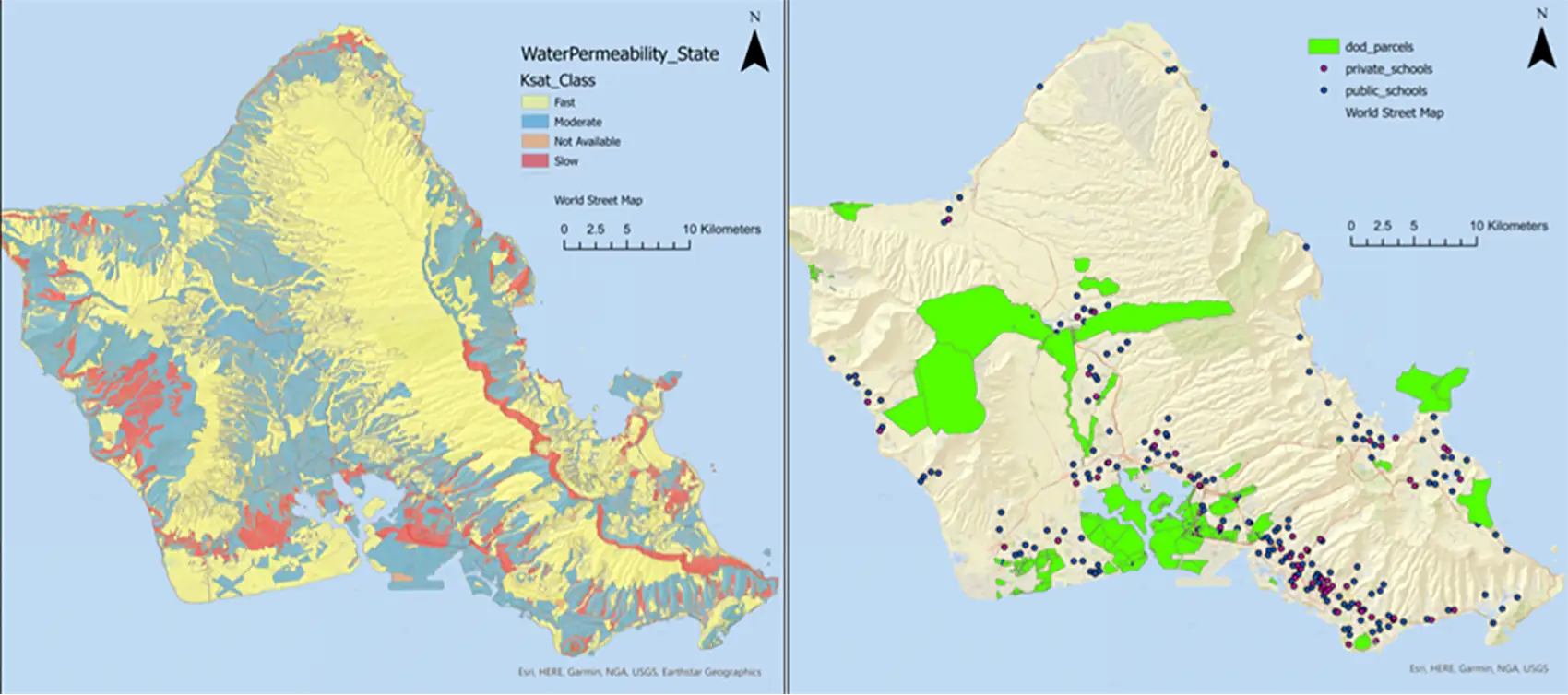
Left: A geographic information system map of Oahu depicts different soil permeability zones (“Ksat_Class” indicates the potential speed of groundwater flow). Right: Locations of U.S. Department of Defense lands and public and private schools—potential customers for GHE—are shown.
<関連情報>
- https://www.nrel.gov/news/detail/program/2025/new-report-illuminates-geothermal-cooling-potential-in-hawaii
- https://docs.nrel.gov/docs/fy25osti/92819.pdf
- https://escholarship.org/uc/item/7qh9n28d
ハワイ大学浅層地熱資源エネルギー技術イノベーションパートナーシッププロジェクト最終報告書(2025年1月) University of Hawai‘i Shallow Geothermal Resources Energy Technology Innovation Partnership Project Final Report, January 2025
Doughty, Christine;Hu, Jianjun;Ulrich, Craig;Murphy, Sean;Dobson, Patrick;Lautze, Nicole;Thomas, Donald;Campton, Mike;et al.
Lawrence Berkeley National Laboratory Published:2025-05-01
Abstract
Executive Summary Scientists at Lawrence Berkeley National Laboratory (Berkeley Lab) have teamed up with the University of Hawai‘i at Manoa (UH Manoa) through the U.S. Department of Energy’s Energy Technology Innovation Partnership Project to evaluate the technological and market feasibility of shallow geothermal heat exchanger (GHE) technology. UH requested this analysis to evaluate opportunities in building cooling, energy efficiency, and emissions reduction applications in Hawai‘i. UH has an abundance of geologic and geothermal data and is looking to the national labs’ expertise to execute this analysis. UH is also interested in investigating policy, regulatory, and business conditions advantageous for implementation of a pilot project and more broad deployment of this technology in Hawai‘i. In many locations around the world, the demands for heating and cooling are roughly balanced over the course of the year, so GHEs do not cause significant long-term changes in subsurface temperature. This is not the case in Hawai’i, where the demand for heating is very small, meaning that, over time, GHEs will add heat to the subsurface. If temperatures increase significantly, GHE systems will not work as designed. Regional groundwater flow has the potential to sweep heated water away from boreholes, thereby maintaining the functionality of the GHE system. Significant regional groundwater flow requires two things: a sufficiently large driving hydraulic head gradient (usually closely related to surface topography), and sufficient porosity and permeability to enable groundwater to flow in large enough quantities to enable near-borehole temperatures to be maintained at ambient values. Hawai‘i’s volcanic terrain offers ample surface topographic variation. The lava itself shows an extremely large range of porosity and permeability, so sites with large enough values of these properties must be selected. Numerical modeling of coupled groundwater and heat flow can be used to determine how large is large enough. Primarily, closed-loop systems have been investigated. Other options considered are open-loop systems and using cool seawater as the chilling source. Project work investigated the feasibility of GHE technology at two scales. At the island scale, GIS layers of various attributes relevant for GHE were combined to develop an overall favorability map for employing GHE in Hawai‘i. At the local scale, a hydrogeologic model for the subsurface component of a closed-loop system was developed for the Stan Sheriff Center at the UH Manoa campus. This site is considered promising because the rock below and immediately downgradient of the borefield is highly permeable, consisting of a subsurface karst system (limestone containing high-permeability open channels), which is underlain by a thick, high-permeability fractured basalt. Moreover, the site is near the base of the Ko‘olau Range, providing a large hydraulic head gradient. Thus, groundwater flow through the site is expected to be large, enabling efficient removal of heated groundwater. A full-GHE-system model of the site was also developed, with a simplified representation of the subsurface, in which groundwater flow is not considered and heat transfer is purely by conduction. Using the building cooling load data provided by UH, simulation results show that with groundwater flow present, a GHE can operate successfully for at least 10 years, but with no groundwater flow, the subsurface begins to heat up after only one year of operation, making the GHE unviable within 2-6 years. The team also developed a techno-economic model for this site to compare the cost of cooling using a GHE system with the costs of operating the current air-conditioning system. The GHE system is advantageous economically if favorable tax incentives and interest rates can be obtained.