2025-08-21 スイス連邦工科大学ローザンヌ校(EPFL)
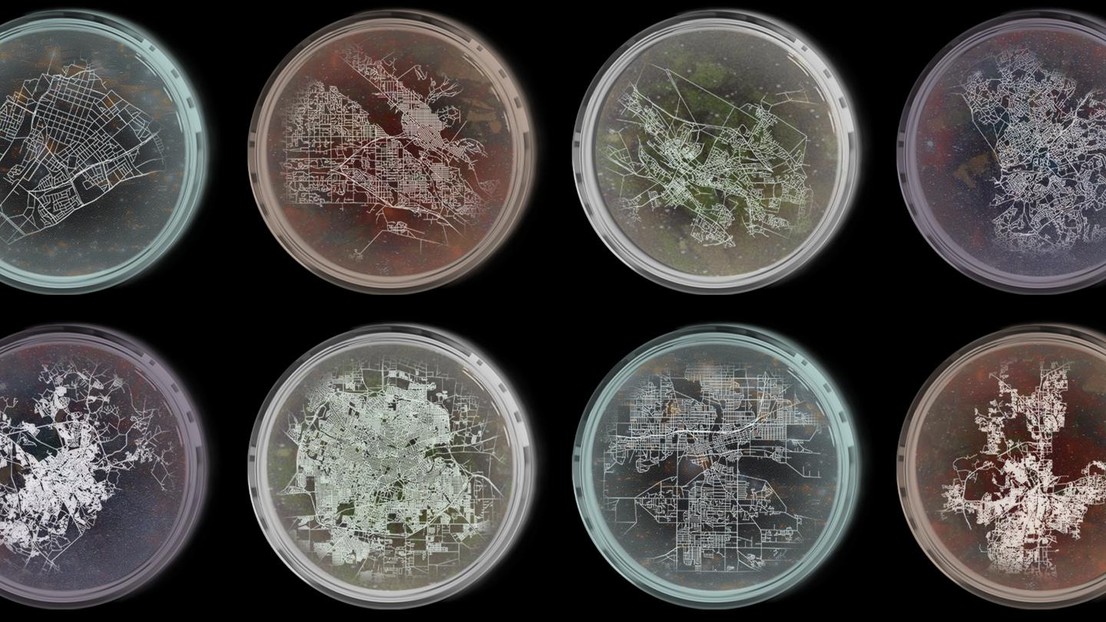
Cities like living organisms, an illustration by Alicia Crespo Montañes, EPFL URBES, 2025
<関連情報>
- https://actu.epfl.ch/news/cities-obey-the-same-laws-of-living-systems/
- https://www.pnas.org/doi/10.1073/pnas.2501224122
都市代謝の確率論的理論 A stochastic theory of urban metabolism
Martin Hendrick, Andrea Rinaldo, and Gabriele Manoli
Proceedings of the National Academy of Sciences Published:August 11, 2025
DOI:https://doi.org/10.1073/pnas.2501224122
Significance
Cities can be viewed as living organisms and their metabolism as the set of processes controlling their evolving structure and function. Urban population, transport networks, and all anthropogenic activities have been proposed to mimic body mass, vascular systems, and metabolic rates of living organisms. This analogy is supported by the emergence of seemingly universal scaling laws linking city-scale quantities to population size. However, such scaling relations critically depend on the choices of city boundaries and neglect intraurban variations of urban properties. By capitalizing on today’s availability of high-resolution data, findings emerge on the generality of small-scale covariations in city characteristics and their link to city-wide averages, thus opening broad avenues to understand and design future urban environments.
Abstract
A current tenet in the science of cities is the emergence of power-law relations between population size and a variety of urban indicators, echoing allometric scaling in living organisms akin to Kleiber’s law. However fascinating, existing scaling theories suffer from biases related to the ad-hoc definition of city boundaries and to their neglect of intraurban variability of city properties. Here, to deal rigorously with biases, we explore the hypothesis that the empirical statistics of intracity variations in population counts, road networks, and carbon emissions-across various cities and spatial scales-can be interpreted as resulting from the joint fluctuations of spatially dependent random variables. Rather than relating urban characteristics to overall city size, we focus on how intraurban properties and local population patterns vary together across space. We find that the marginal and joint probability distributions are characterized by finite-size scaling functions which, upon suitable rescaling, collapse onto a set of universal curves. These results are analogous to those relating intraspecies variability in living organisms where the scaling of mean body mass with a characteristic metabolic rate clouds the effects of the variance of both traits. Our findings lay the foundations for a generalized theory of urban metabolism, linking city-scale quantities to the covariation of intraurban characteristics. This also opens up opportunities for a full exploitation of available urban data allowing the integration of biologically inspired theories into the modeling and planning of cities.